

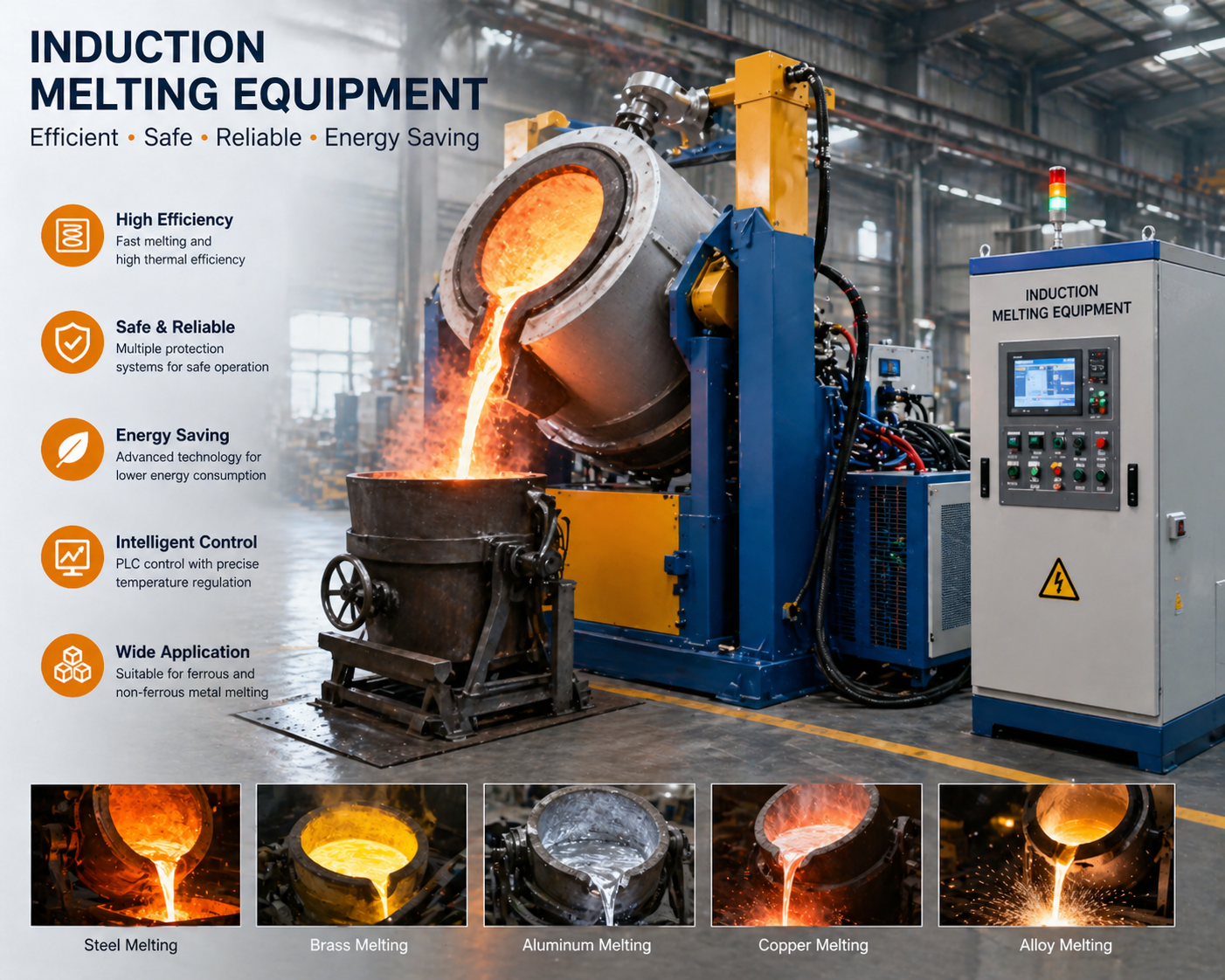
Induction Melting Equipment
The Physical Properties of Solid Aluminum: A Technical Guide
Aluminum is a light metal defined by its low density and high versatility. The density of solid pure aluminum is approximately 2.7 g/cm³, roughly one-third that of iron or copper. While density varies slightly with purity, the most significant industrial advantages of aluminum lie in its electrical and thermal performance.
1. Electrical Conductivity and Resistivity
Pure aluminum is an exceptional conductor of electricity. For high-purity aluminum (99.990%), the physical specifications at 20°C are as follows:
-
Resistivity ($\rho$): $2.6548 \times 10^{-8} \, \Omega \cdot \text{m}$
-
Volume Conductivity: 64.94% IACS (International Annealed Copper Standard).
-
Electrical Grade Aluminum: Typically maintains a volume conductivity of at least 62% IACS.
Sensitivity to Purity and Temperature
Aluminum’s electrical performance is highly sensitive to its environment and composition:
-
Temperature: As temperature rises, resistivity increases and conductivity decreases.
-
Purity: Conductivity drops sharply as impurities increase. In the melting and casting process for electrical-grade aluminum, maintaining high purity is critical to meeting performance standards.
2. Aluminum vs. Copper: The Efficiency Comparison
While aluminum’s conductivity is only about 65% of copper’s, its significantly lower density makes it the superior choice for power transmission in terms of weight-to-performance.
| Property | Pure Aluminum | Pure Copper |
| Density | 2.7 g/cm³ | 8.9 g/cm³ |
| Conductivity (IACS) | ~65% | 100% |
| Density Ratio (Al/Cu) | 32.1% | 100% |
The Result: To achieve the same electrical carrying capacity, the mass of aluminum required is only 46% of the mass of copper required. This makes aluminum the “gold standard” for manufacturing lightweight high-voltage wires and cables.
3. Optical Properties and Reflectivity
Aluminum is a silver-white metal with high specular and diffuse reflectivity. This makes it a preferred material for both aesthetic and functional shielding applications.
-
Visible Light: Polished aluminum surfaces reflect more than 80% of white light.
-
Broad Spectrum: Aluminum effectively reflects infrared (IR), ultraviolet (UV), electromagnetic waves, and thermal radiation.
-
Food Industry Application: Because high-purity aluminum is both highly reflective and exceptionally corrosion-resistant, it is the primary material for food packaging, protecting contents from light and heat.
4. Thermal Diffusivity and Industrial Use
Aluminum’s ability to move heat is nearly on par with copper, which is reflected in its high thermal diffusivity.
-
Thermal Diffusivity ($a$) at Room Temperature:
-
Pure Copper: $1.14 \, \text{cm}^2/\text{s}$
-
Pure Aluminum: $0.98 \, \text{cm}^2/\text{s}$
-
Due to this high thermal efficiency, aluminum and its alloys are frequently used as mold materials in continuous casting operations, where rapid heat extraction is necessary to solidify the molten metal.
Technical FAQ
Q: Why does aluminum’s conductivity decrease with impurities?
A: Impurities create “lattice distortions” in the atomic structure of the aluminum. These distortions scatter electrons as they move through the metal, increasing resistance.
Q: Can aluminum be used for high-heat shielding?
A: Yes. Because it reflects infrared and heat radiation so well, aluminum is used in everything from emergency blankets to heat shields in automotive engine bays.
Q: How does 20°C affect the measurement of resistivity?
A: 20°C is the international standard reference temperature. Since resistivity ($\rho$) is temperature-dependent, measuring at this standard allows for accurate comparison between different batches and materials.