

JPW Industrial Ovens and Furnaces | Precision Heat Treat Systems for Aerospace & Medical
JPW Industrial Ovens and Furnaces: Precision Heat Treat Systems for Aerospace, Medical & Energy Industries
When industrial heat treatment determines certification, compliance, and product lifespan, equipment precision is not optional — it is foundational.
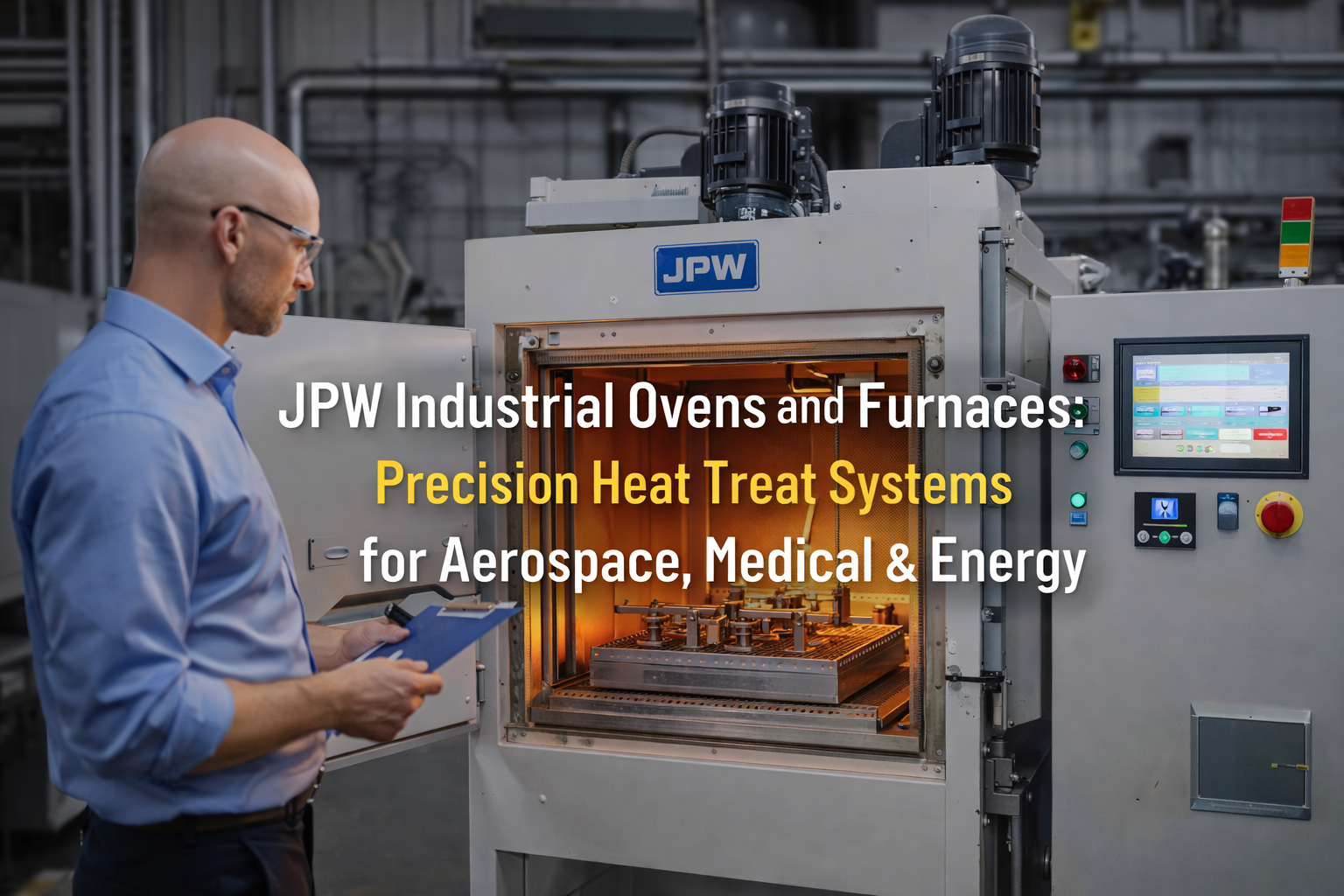
JPW Industrial Ovens and Furnaces have built a 40+ year legacy in precision heat treat design, delivering batch and continuous furnace systems engineered for aerospace alloys, medical implants, energy components, and high-performance manufacturing environments.
This guide explores:
-
What makes JPW industrial heat treat systems different
-
Types of ovens and furnaces available
-
Real-world performance data
-
Compliance with AMS 2750E & ISO 13485
-
ROI and long-term cost implications
-
Integration guidance for manufacturers
What Sets JPW Industrial Ovens and Furnaces Apart?
Industrial ovens are common. Precision thermal systems are not.
JPW systems are engineered around controlled thermal behavior, not simply heating capacity. Their designs integrate airflow modeling, insulation science, sensor redundancy, and validation protocols from the earliest engineering phase.
Unlike commodity industrial ovens, JPW equipment routinely achieves:
-
AMS 2750E Class 1 & Class 2 compliance
-
±1.5°F to ±3°F uniformity
-
Certified temperature uniformity surveys (TUS)
-
Validation-ready documentation for audit environments
In industries where thermal deviation can cause structural failure or compliance rejection, this level of control is essential.
Core Product Categories: Industrial Heat Treatment Systems
JPW specializes in both batch heat treatment furnaces and continuous process thermal systems, designed to match process physics — not just load size.
Batch Box Ovens for Aerospace and Tool Steel Applications
Batch ovens are designed for static load processes including:
-
Aging
-
Stress relieving
-
Tempering
-
Solution heat treatment
-
Annealing
JPW batch box ovens feature:
-
Double-wall insulated construction
-
Vacuum-jacketed insulation systems
-
Dual independent recirculation fans
-
Multi-zone thermocouple feedback
-
Uniformity up to ±1.5°F
For aerospace manufacturers requiring AMS 2750E Class 1 compliance, this ensures certification readiness without costly retrofitting.
Typical Performance Comparison
Continuous Belt Furnaces for High-Volume Production
For throughput-driven industries such as:
-
Automotive fasteners
-
Surgical components
-
Electronic connectors
-
Small precision components
JPW continuous belt furnaces offer:
-
Adjustable belt speeds (0.5–12 in/min)
-
Segmented heating zones
-
Independent zone temperature control
-
Integrated quench and cooling stages
-
In-line monitoring and pyrometry
The result is predictable hardness profiles across 10,000+ parts per hour with reduced process variability.
Vacuum and Controlled Atmosphere Furnaces
Oxidation-free processing is critical in:
-
Medical implant manufacturing
-
Stainless steel bright annealing
-
Aerospace component carburizing
-
Precision gear hardening
JPW vacuum furnace systems achieve:
-
10⁻⁶ Torr base pressure
-
Multi-gas input control (N₂, H₂, Argon blends)
-
Mass flow controllers ±0.5% accuracy
-
Real-time oxygen monitoring
-
ISO 13485 compliant logging
For regulated industries, traceability is built into the architecture.
Real-World Applications and Performance Impact
Precision engineering only matters if it translates to measurable operational benefits.
Aerospace Manufacturing: AMS 2750E Compliance
A Tier-1 aerospace supplier reported:
-
37% faster qualification cycle
-
$220,000 saved in third-party validation
-
6-week reduction in NADCAP audit timeline
This was achieved because the furnace arrived pre-certified and factory validated.
Medical Device Manufacturing: ISO 13485 Validation
An orthopedic implant manufacturer reported:
-
Zero thermal-related non-conformances over 18 months
-
Full digital traceability of process logs
-
Automatic deviation alerts to prevent scrap
In FDA-regulated industries, this is operational security.
Renewable Energy Components
For large wind turbine hubs (up to 18 tons):
-
±0.8°F variation across 12 consecutive cycles
-
Elimination of thermal bowing
-
Repeatable 600°C stress relief cycles
For heavy component producers, consistency directly impacts structural integrity.
Advantages vs Limitations: A Balanced View
Key Advantages
-
Industry-leading temperature uniformity
-
Extended refractory and heater lifespan
-
28% average reduction in gas consumption (via heat recovery)
-
Reduced rework and scrap rates
-
Seamless PLC and MES integration
Investment Consideration
JPW systems typically carry a 22–35% premium compared to entry-tier ovens.
However, ROI for high-mix manufacturers often occurs within 18–24 months due to:
-
Reduced scrap (up to 19%)
-
Lower engineering validation labor
-
Extended maintenance intervals
-
Energy savings
For mission-critical industries, long-term TCO outweighs initial capital cost.
Integration and Selection Guidance
Before selecting a heat treat furnace, manufacturers should evaluate:
-
Largest dimensional load envelope
-
Highest scrap-producing process stage
-
Atmosphere control requirements
-
Certification standards (AMS, ISO, internal specs)
-
PLC integration requirements
JPW systems support:
-
EtherNet/IP
-
Modbus TCP
-
OPC UA
-
Rockwell / Siemens integration
-
SCADA and MES connectivity
Factory Acceptance Testing (FAT) and validation documentation are included.
Frequently Asked Questions
How is temperature uniformity validated?
JPW performs Temperature Uniformity Surveys using 9–16 calibrated thermocouples per AMS 2750E standards with 1-second data logging intervals and NIST traceability.
Can custom atmosphere blends be supported?
Yes. Up to 4 gas inputs with programmable blends and mass flow control are supported.
What maintenance ensures ±1.5°F performance long-term?
-
Quarterly thermocouple verification
-
Annual airflow and duct inspection
-
Biennial heater resistance testing
-
Auto-calibration software routines
Field data shows 92% of units maintain original uniformity specs after 12 years.
Key Takeaways
JPW Industrial Ovens and Furnaces are not commodity heating units — they are engineered thermal control systems designed for:
-
Aerospace certification
-
Medical compliance
-
High-volume manufacturing stability
-
Long-term operational ROI
If your production economics, compliance status, or safety margins depend on thermal precision, engineering depth matters more than initial purchase price.