
Tungsten and Niobium for Induction Furnace Melting
Tungsten and Niobium Charge Materials for Induction Furnaces
1. Metallic Tungsten
Metallic tungsten powder is obtained by reducing tungsten trioxide with hydrogen:
WO₃ + 3H₂ → 3H₂O + W
The tungsten powder is pressed and sintered to produce metallic tungsten bars. Because the WO₃ feedstock has a relatively high purity, the resulting metallic tungsten is also highly pure. Its chemical composition is listed in Table 4-6 of the source.
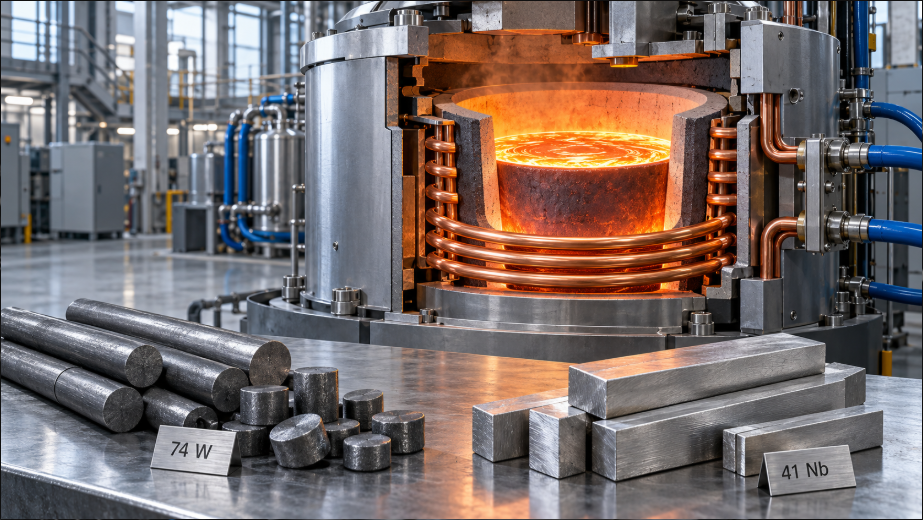
Metallic tungsten is mainly used for melting nickel-based high-temperature alloys, precision alloys, and other alloys with restricted iron contents. It serves as a tungsten-bearing charge material in induction furnace alloy production.
2. Ferrotungsten
Ferrotungsten is an iron alloy containing 65%–80% tungsten, together with impurities such as copper, sulfur, and tin. Ferrotungsten containing 65%–70% tungsten has a density of approximately 16.4 g/cm³ and a melting range of 1,700–2,000°C. It is hard and difficult to crush.
Ferrotungsten is produced by reducing wolframite concentrate with silicon, aluminum, or carbon in an electric arc furnace. The principal reactions are:
FeWO₄ + 4C → W + Fe + 4CO↑
2FeWO₄ + 4Si → 2W + 2Fe + 4SiO₂
3FeWO₄ + 8Al → 3W + 3Fe + 4Al₂O₃
Impurity oxides in the concentrate are also reduced and enter the ferrotungsten. Copper and tin are among the main impurities introduced in this way. The carbon, silicon, and manganese contents of the ferrotungsten described in the source do not materially affect the steel’s chemical composition.
The chemical composition of ferrotungsten is listed in Table 4-7 of the source. High-tungsten grades can be used for melting iron-based high-temperature alloys and precision alloys. Other grades are suitable for producing tungsten-bearing steels.
3. Tungsten Concentrates
Tungsten concentrates include wolframite concentrate and calcium tungstate concentrate, also known as scheelite concentrate. They can be used to produce tungsten-bearing alloy structural steels.
During melting, a measured quantity of concentrate powder is added to the slag layer in the steel melting furnace. Aluminum powder or silicon–calcium alloy powder is then used to reduce the WO₃ in the slag, allowing the recovered tungsten to enter the molten steel.
Wolframite concentrate contains approximately 75% WO₃ and 25% combined FeO and MnO. Its density is approximately 7.14–7.50 g/cm³, and its melting point is about 1,500°C.
Scheelite concentrate contains approximately 70%–80% WO₃, with the remainder mainly consisting of CaO. Its density is approximately 5.9–6.1 g/cm³. Pure WO₃ has a melting point of 1,473°C.
Metallic Niobium and Niobium Ferroalloys
Niobium is an alloying element used for specialized applications. Materials used to introduce niobium during alloy melting include metallic niobium, ferroniobium, niobium–tantalum ferroalloys, and niobium–manganese alloys.
1. Metallic Niobium
Pure niobium is a white metal with a melting point of 2,468°C, a boiling point of 4,750°C, and a density of 8.57 g/cm³.
The production of metallic niobium is relatively complex. Niobium–tantalum concentrate is first separated and processed by hydrometallurgical methods to obtain potassium heptafluoroniobate, K₂NbF₇. Niobium powder is then produced by molten-salt electrolysis or reduction with metallic sodium.
The sodium reduction reaction is:
K₂NbF₇ + 5Na → Nb + 5NaF + 2KF (4-9)
The niobium powder is compacted, sintered under vacuum, and then forged into niobium bars. Table 4-8 gives the chemical composition limits and typical applications of these bars.
Table 4-8. Chemical Composition of Niobium Bars — YB 521-79
All composition values are maximum contents, expressed as percentages.
| Element | Nb-01 | Nb-1 | Nb-2 |
|---|---|---|---|
| Tantalum, Ta | 0.1 | 0.50 | 2.0 |
| Oxygen, O | 0.06 | 0.10 | 0.08 |
| Nitrogen, N | 0.04 | 0.08 | 0.1 |
| Carbon, C | 0.02 | 0.03 | 0.8 |
| Silicon, Si | 0.005 | 0.01 | 0.10 |
| Iron, Fe | 0.005 | 0.03 | 0.80 |
| Tungsten, W | 0.005 | 0.01 | – |
| Molybdenum, Mo | 0.005 | 0.01 | – |
| Titanium, Ti | 0.005 | 0.01 | – |
| Aluminum, Al | – | – | 0.20 |
| Copper, Cu | 0.003 | 0.01 | 0.02 |
| Chromium, Cr | – | – | 0.03 |
| Phosphorus, P | – | – | 0.03 |
| Typical application | Superconducting materials | Feedstock for ingot melting | Alloy additions |
2. Ferroniobium and Niobium–Tantalum Ferroalloys
Niobium and tantalum are elements with similar properties. They occur together in columbite–tantalite minerals, (Fe, Mn)O·(Nb, Ta)₂O₅, and fluoride-bearing minerals, (Na, Ca)₂·(Nb, Ta, Ti)₂(O, F)₇.
Ferroniobium contains 50%–65% Nb and less than 1% Ta. Its density is approximately 8 g/cm³, and its melting range is 1,520–1,600°C.
Niobium–tantalum ferroalloy contains a combined Nb and Ta content of 50%–65%, with approximately 10% Ta. Its density is approximately 8.4 g/cm³, and its melting range is 1,570–1,650°C.
Both ferroalloys are produced by aluminothermic reduction of niobium-bearing or niobium–tantalum-bearing concentrates in an electric arc furnace. These materials provide niobium additions for subsequent steel and alloy melting.