

First Refining Preparation and Temperature Control for Aluminum Melt
What Preparations Should Be Made Before First Refining?
During charging and melting, the floating slag on the melt surface should be skimmed off at the end of the process, and all furnace doors should then be closed. After that, the furnace should be powered on for heat preservation, and the furnace temperature should be set to the specified refining temperature.
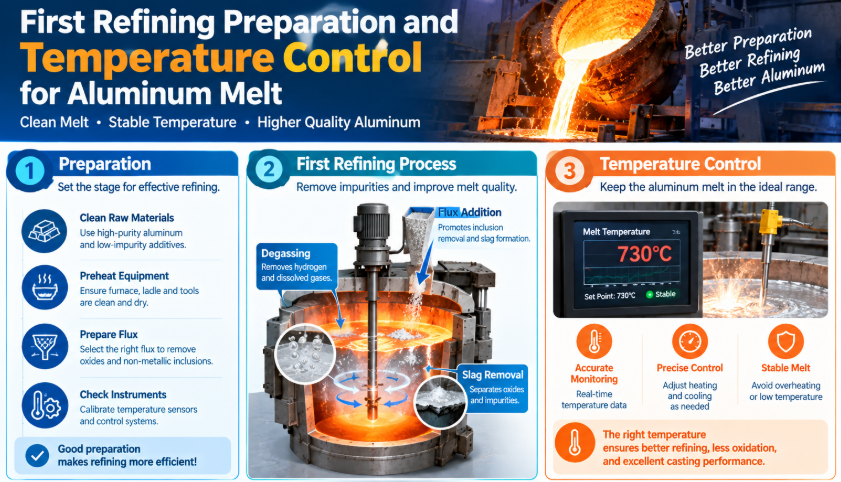
Before first refining, the furnace temperature should be checked to confirm that it meets the required refining temperature. At the same time, the amount of flux in the furnace should be checked to ensure it is sufficient. The drying furnace temperature should also meet the specified requirement, generally around 150°C. Operating tools must be dried, and their preheating temperature should be kept above 120°C.
When refining is required, the furnace power supply should be disconnected, and a “power off for operation” warning sign should be hung at the operating switch. Then open the furnace door at the operating position, while all other furnace doors should remain closed.
How Should the First Refining Temperature Be Determined?
When selecting the refining temperature, three factors should be considered: the effect of temperature on refining efficiency, the thermal effect between the melt and refining gas, and the influence of temperature on the physical and chemical processes during melting.
The lower the viscosity of the aluminum alloy melt, the better the degassing and slag-removal effect. Conversely, the higher the viscosity, the more difficult degassing and slag removal become. The viscosity of aluminum alloy melt depends on its chemical composition and temperature. As the temperature rises, the viscosity decreases. From the perspective of viscosity, the melt temperature should be as high as possible. However, the gas absorption of the melt also increases as temperature rises, so the refining temperature should not be too high.
The refining temperature is also related to the chemical composition of the alloy. For example, 413Z.1 (ZL-102) aluminum-silicon alloy contains no Mg, and its refining temperature is usually 700-720°C. The 356Z.1 (ZL-101) alloy contains 0.2%-0.4% Mg. Test results show that refining temperature has a significant influence on the degassing effect of hexachloroethane (C2Cl6) for this alloy.
When other conditions are the same, within the range of 710-750°C, the hydrogen content in the alloy decreases as the refining temperature increases. When refining is carried out at 740-750°C, the hydrogen content reaches its lowest level. When refining is carried out at 700-710°C, pores are more likely to appear on the casting surface.
This may be because C2Cl6 reacts chemically with the alloy melt during refining and forms MgCl2, which has a melting point of 718°C. At 700-710°C, MgCl2 remains solid. Solid MgCl2 cannot participate effectively in the degassing reaction, and it may wrap around the surface of gas bubbles, preventing hydrogen from diffusing into the bubbles. This is unfavorable for degassing.
Table 6-1 Relationship Between Hydrogen Content in Aluminum Alloy and Refining Temperature
| Refining Temperature | 710°C | 730°C | 740°C |
|---|---|---|---|
| Hydrogen content before refining, cm³/100 g metal | 0.99 | 1.00 | 1.00 |
| Hydrogen content after refining, cm³/100 g metal | 0.12 | 0.09 | 0.06 |
Therefore, based on production practice, some factories use a refining temperature of 730-750°C with C2Cl6 for magnesium-containing aluminum-silicon alloys such as 356Z.1 (ZL-101), 360Z.6 (ZL-104), and 355Z.1 (ZL-105).
When refining is carried out in a melting furnace, the refining temperature can be kept within the normal melting temperature range. For chlorine blowing refining, chlorine reacts with hydrogen in the bubbles and keeps the hydrogen concentration at the bubble-melt interface very low. Increasing the temperature can greatly accelerate the chemical reaction between the refining gas and hydrogen in the bubbles. It can also improve the mass transfer coefficient of hydrogen diffusing from the melt into the bubbles, which helps improve refining efficiency.
However, the formation reactions of AlCl3 and HCl are exothermic and can raise the melt temperature. When the chlorine flow rate is 1 m³/t of metal, the temperature may increase by about 10°C. Therefore, the temperature is generally controlled at 730-740°C.
For nitrogen blowing refining, nitrogen absorbs heat, but the resulting drop in melt temperature is very small. Without considering other conditions, when the gas flow rate is 1 m³/t of metal, the melt temperature decreases by less than 1°C. Although a lower temperature reduces the diffusion speed of atomic hydrogen in the melt, it increases melt viscosity, extends the residence time of bubbles in the melt, and increases the partial pressure of dissolved hydrogen. This is beneficial for diffusion-based hydrogen removal. Therefore, the refining temperature for nitrogen refining should be slightly lower, generally 710-720°C. For refining with a nitrogen-chlorine mixed gas, 720-730°C is usually suitable.
In a mixing furnace or holding furnace, the upper limit of the casting temperature can be used as the lower limit of the refining temperature. The upper limit of the refining temperature can be set about 15°C higher than the upper limit of the casting temperature. Practice has shown that refining within this temperature range is relatively suitable.
When solid aluminum ingots are used as the main raw material in the melting process, some producers recommend keeping the refining temperature at around 690°C. After the flux is added, the temperature should be raised quickly to 720-730°C for casting.