

Manufacturing Example of a 500 kg Magnesia Crucible
Manufacturing Example of a 500 kg Magnesia Crucible
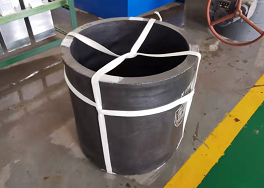
1. Equipment Overview
The crucible capacity is 500 kg. The power supply has a rated power of 250 kW and a frequency of 2500 Hz. It is powered by a medium-frequency generator set.
The crucible is mainly used for producing stainless steel, precision alloys, and similar materials.
2. Magnesia Sand and Particle Size Ratio
First-grade metallurgical magnesia sand with an MgO content of at least 87% is used as the ramming material for the crucible. The particle size ratio is as follows:
| Magnesia Particle Size, mm | Ratio, % |
|---|---|
| 1-3 | 45 |
| 0.5-1 | 20 |
| <0.5 | 35 |
The amount of boric acid added is 1.8-2.0% of the sand weight, and the water content is 2%.
3. Crucible Ramming
A steel plate core is used, and the crucible is rammed manually with pneumatic tools.
3.1 Preparation
The inner wall of the induction coil should be coated with an insulating and heat-insulating layer. The coating formula is as follows:
| Material | Ratio |
|---|---|
| Refractory clay | 50% |
| Asbestos slurry | 3-4% |
| Cement, grade 400 or above | 46-47% |
After adding water and mixing the coating evenly, apply it to the inner wall of the induction coil. The coating thickness should be about 3-5 mm. After 24 hours of natural drying or oven drying, crucible ramming can begin.
Once the coating is dry, lay 1-2 layers of glass fiber cloth on the inner wall of the inductor. Then prepare to add the sand material for ramming.
Mix the sand material and boric acid first, then add water and stir evenly. The mixture is then ready for use.
3.2 Ramming the Furnace Bottom
The furnace bottom is rammed in four batches. Add 30 kg of sand material for each of the first three batches, and 15 kg for the fourth batch.
Each layer should be rammed with a pneumatic tool for 15-20 minutes. The final compacted hard sand layer at the furnace bottom should be 160-170 mm thick.
3.3 Placing the Steel Plate Core
The steel plate core must be placed upright and fixed firmly. Add weights inside the core to prevent it from moving during ramming.
3.4 Ramming the Crucible Wall
When ramming the crucible wall, add 15 kg of sand material per batch. A total of nine batches are added. Each batch should be rammed for 15-20 minutes.
The first and second batches should each be rammed for at least 20 minutes. When the compacted sand layer reaches 160-170 mm below the furnace platform surface, begin ramming the furnace mouth.
3.5 Ramming the Furnace Mouth
The sand material and particle size ratio for ramming the furnace mouth are as follows:
| Material | Ratio |
|---|---|
| 1-3 mm magnesia sand | 40% |
| 0.5-1 mm magnesia sand | 40% |
| Clay powder | 20% |
| Boric acid | 4-5% |
| Water | 2% |
The furnace mouth must be rammed firmly. After that, build the furnace mouth bricks and install the tapping spout. At this point, the crucible forming process is complete.
4. Crucible Sintering
The sintering method combines low-temperature sintering with the steel plate core and high-temperature sintering with graphite blocks.