

How Long Should Aluminum Melting Time Be Controlled?
How Long Should Melting Time Be Controlled?
Melting time refers to the total time from the start of charging and heating the furnace charge to the discharge of the melt from the furnace. It is the total time that the charge remains in the melting furnace in solid and liquid forms.
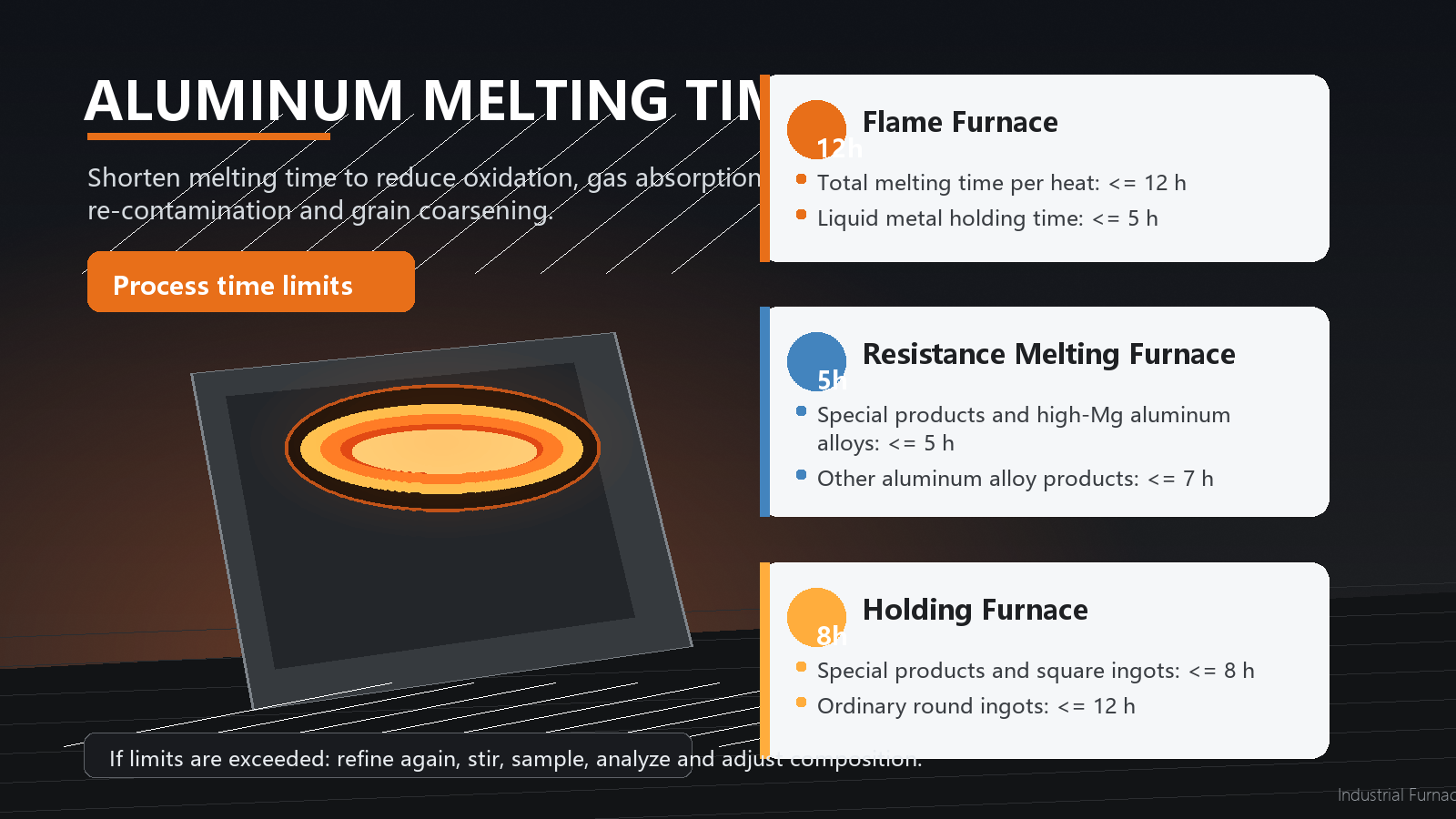
The longer the melting time, the more serious the oxidation and gas absorption of the charge, especially the liquid aluminum melt. The tendency of ingots to form coarse crystal structures and cracks also increases. At the same time, the productivity of the melting furnace decreases.
For the refined melt, the longer it stays in the furnace, the greater the possibility of re-contamination, composition change, and failure of grain refinement treatment.
Therefore, under the premise of ensuring the time required to complete a series of process operations, the melting time should be shortened as much as possible.
According to production practice in aluminum processing plants, the allowable holding time varies in different furnaces. The general requirements are as follows:
1. Flame Furnace
For each heat, the total melting time must not exceed 12 hours, and the holding time of liquid metal must not exceed 5 hours.
2. Resistance Melting Furnace
The time from sampling to the start of tapping must not exceed 5 hours for special products and high-magnesium aluminum alloys.
For other aluminum alloy products, it must not exceed 7 hours.
In electrolytic aluminum plants, when liquid primary aluminum is used as the main charge material, this melting time limit should be followed.
3. Holding Furnace
The time from the completion of transferring the aluminum melt to the start of the final casting must not exceed 8 hours for special products and square ingots.
For ordinary round ingots, it must not exceed 12 hours.
Corrective Measures When Melting Time Exceeds the Limit
When the melting time exceeds the above requirements, the following corrective measures should generally be taken:
- Supplementary refining
- Re-stirring
- Sampling and analysis
- Adjustment of chemical composition, especially for aluminum alloys with high magnesium content
- Adding 0.01% to 0.03% titanium, when permitted.