

Industrial Furnace Temperature Control | Energy Efficiency, Stability & ROI Optimization
1. What Is Industrial Furnace Temperature and Why It Matters
Industrial furnace temperature refers to the controlled thermal range required for specific metallurgical or heat treatment processes.
It is not simply about “how hot the furnace can get.”
It is about:
-
Temperature stability (± tolerance)
-
Heat distribution uniformity
-
Response speed
-
Control precision
-
Thermal efficiency
For factory owners and steel plant managers, furnace temperature directly influences:
-
Energy cost per ton
-
Production speed
-
Product quality consistency
-
Equipment lifespan
-
Compliance risk
A furnace that reaches high temperatures but fluctuates excessively will:
-
Increase oxidation
-
Waste energy
-
Cause inconsistent output
-
Shorten refractory life
Precision is profit.
2. Optimal Temperature Ranges by Application
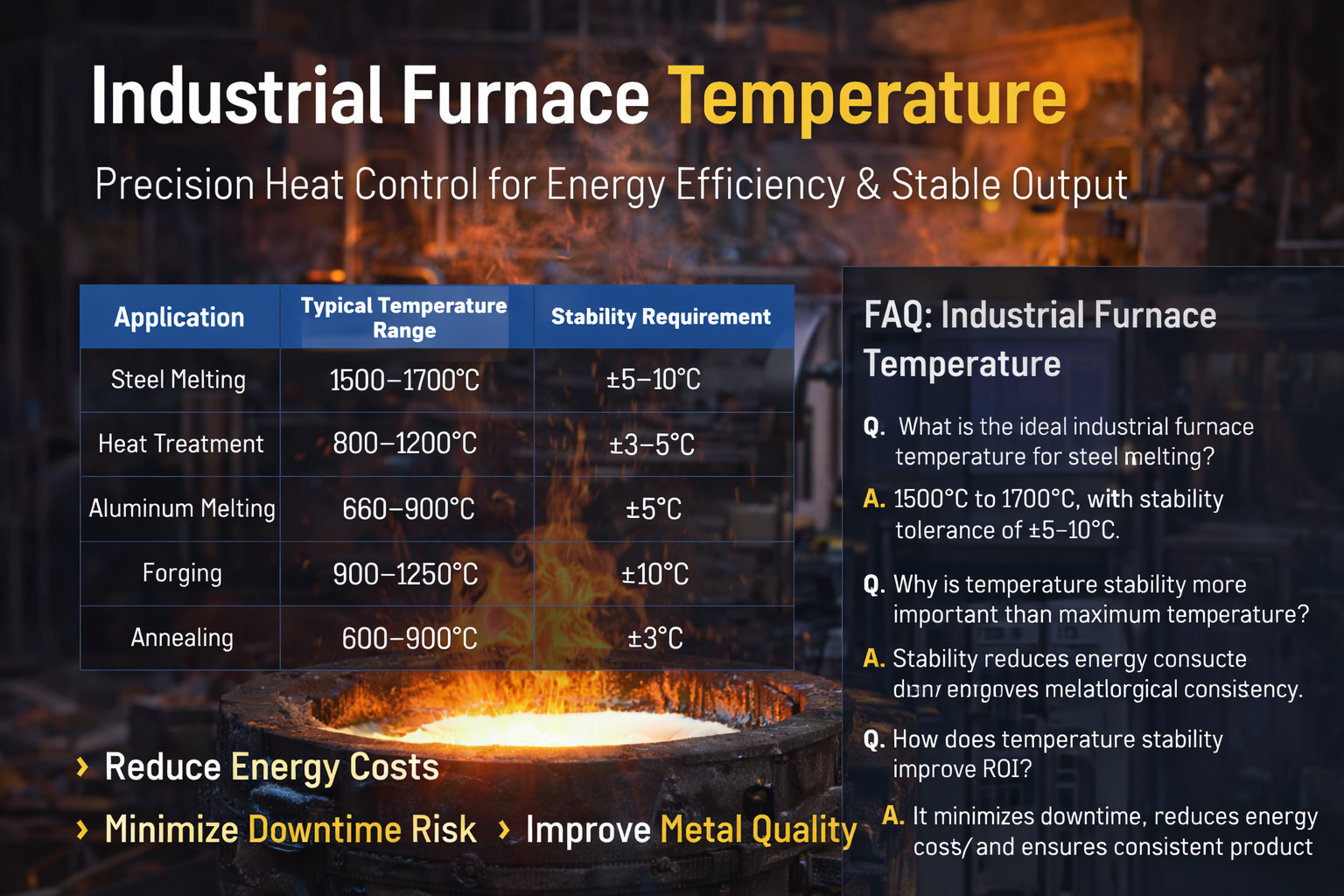
Industrial furnace temperature requirements vary by process. Below is a reference table used in engineering planning:
| Application | Typical Temperature Range | Stability Requirement | Key Risk if Unstable |
|---|---|---|---|
| Steel Melting | 1500–1700°C | ±5–10°C | Inclusion & oxidation |
| Heat Treatment | 800–1200°C | ±3–5°C | Hardness deviation |
| Aluminum Melting | 660–900°C | ±5°C | Metal loss |
| Forging | 900–1250°C | ±10°C | Surface cracks |
| Annealing | 600–900°C | ±3°C | Grain inconsistency |
Key Insight:
Temperature range alone does not define performance. Stability tolerance does.
A furnace capable of 1700°C with ±50°C deviation is operationally inferior to one with ±5°C control.
3. How Temperature Stability Reduces Energy Costs
Energy accounts for a significant portion of furnace operating expenses.
Unstable industrial furnace temperature leads to:
-
Reheating cycles
-
Excessive holding time
-
Energy spikes
-
Thermal loss
A precision temperature control system delivers:
1. Faster Heat-Up Time
Advanced power matching reduces ramp-up duration.
2. Reduced Overheating
Avoiding unnecessary temperature overshoot saves electricity.
3. Lower Idle Loss
Optimized insulation minimizes standby heat dissipation.
4. Smart Power Modulation
Real-time load adjustment prevents energy waste.
Result:
-
Reduced kWh per ton
-
Lower fuel consumption
-
Predictable monthly operating costs
-
Faster return on capital investment
Energy efficiency is not theoretical. It is measured over thousands of operating hours.
4. Temperature Control and Production Cycle Optimization
Production speed depends on thermal responsiveness.
A modern high temperature industrial furnace must:
-
Reach target temperature quickly
-
Maintain uniform distribution
-
Adjust dynamically to load changes
Stable temperature control shortens:
-
Melting cycles
-
Heat treatment soak time
-
Preheating intervals
Faster cycles mean:
-
Increased daily throughput
-
Higher annual production capacity
-
Improved cash flow
For general managers, this directly impacts ROI and payback period.
5. Minimizing Downtime Through Precision Heat Management
Temperature fluctuation is one of the leading causes of furnace failure.
Overheating damages:
-
Refractory lining
-
Coils
-
Power modules
-
Structural components
Advanced furnace temperature management includes:
Thermal Monitoring Sensors
Continuous real-time feedback reduces risk.
Overheat Protection Systems
Automatic shutdown prevents catastrophic damage.
Predictive Maintenance Alerts
Data-based monitoring reduces unexpected stoppage.
Minimizing downtime protects:
-
Delivery commitments
-
Labor efficiency
-
Downstream process coordination
Downtime is not just repair cost. It is opportunity cost.
6. Improving Metal Purity and Output Consistency
Temperature precision directly influences molten metal quality.
In steel and alloy production:
-
Overheating increases oxidation
-
Uneven heating causes segregation
-
Poor control leads to inconsistent chemistry
Precision industrial furnace temperature ensures:
-
Uniform metallurgical structure
-
Reduced inclusion rate
-
Improved casting surface quality
-
Consistent mechanical properties
For engineering managers, output consistency reduces:
-
Rejection rate
-
Rework cost
-
Quality claims
Quality stability strengthens brand credibility.
7. Engineering Strength, Global Support & Long-Term Partnership
Temperature performance depends on more than equipment design.
It requires:
-
Engineering experience
-
Accurate power matching
-
Insulation expertise
-
Cooling system reliability
Our strength includes:
-
Dedicated manufacturing facility
-
Experienced thermal engineering team
-
Strict quality control before shipment
-
Export experience across multiple regions
For overseas clients, we provide:
-
Remote temperature diagnostics
-
Spare parts logistics planning
-
Structured maintenance support
-
Technical documentation assistance
We position ourselves as a long-term industrial partner — not simply a furnace supplier.
8. Addressing Real Investment Concerns
High Investment but Unstable Output
Stable temperature tolerance ensures consistent performance.
Equipment Failure Causing Shutdown Loss
Overheat protection and predictive monitoring reduce breakdown risk.
Inflated Technical Parameters
We provide realistic temperature tolerance data, not theoretical maximum values.
Actual Capacity Lower Than Expected
Cycle time and load configuration are engineered for real output conditions.
Overseas Service Delays
Structured after-sales support and spare parts planning reduce service downtime.
Long Repair Cycles
Modular design simplifies maintenance.
Parts Difficult to Source
Critical components are standardized and globally accessible.
Financing Risk
Energy efficiency and predictable operating cost improve financial forecasting.
Uncontrolled Operational Costs
Temperature precision directly stabilizes energy expenditure.
9. FAQ: Industrial Furnace Temperature
Q1: What is the ideal industrial furnace temperature for steel melting?
Typically between 1500°C and 1700°C, with stability tolerance within ±5–10°C.
Q2: Why is temperature stability more important than maximum temperature?
Stability ensures consistent metallurgical quality and prevents energy waste.
Q3: How does furnace temperature affect energy consumption?
Frequent overheating and reheating cycles significantly increase energy cost.
Q4: What causes temperature fluctuation in industrial furnaces?
Improper power matching, poor insulation, cooling instability, and outdated control systems.
Q5: How can temperature control improve ROI?
Reduced downtime, improved output consistency, and lower energy cost accelerate capital recovery.