

Industrial Furnace Temperature Range | Stability Targets, Energy Efficiency
1. Definition: What Is an Industrial Furnace Temperature Range?
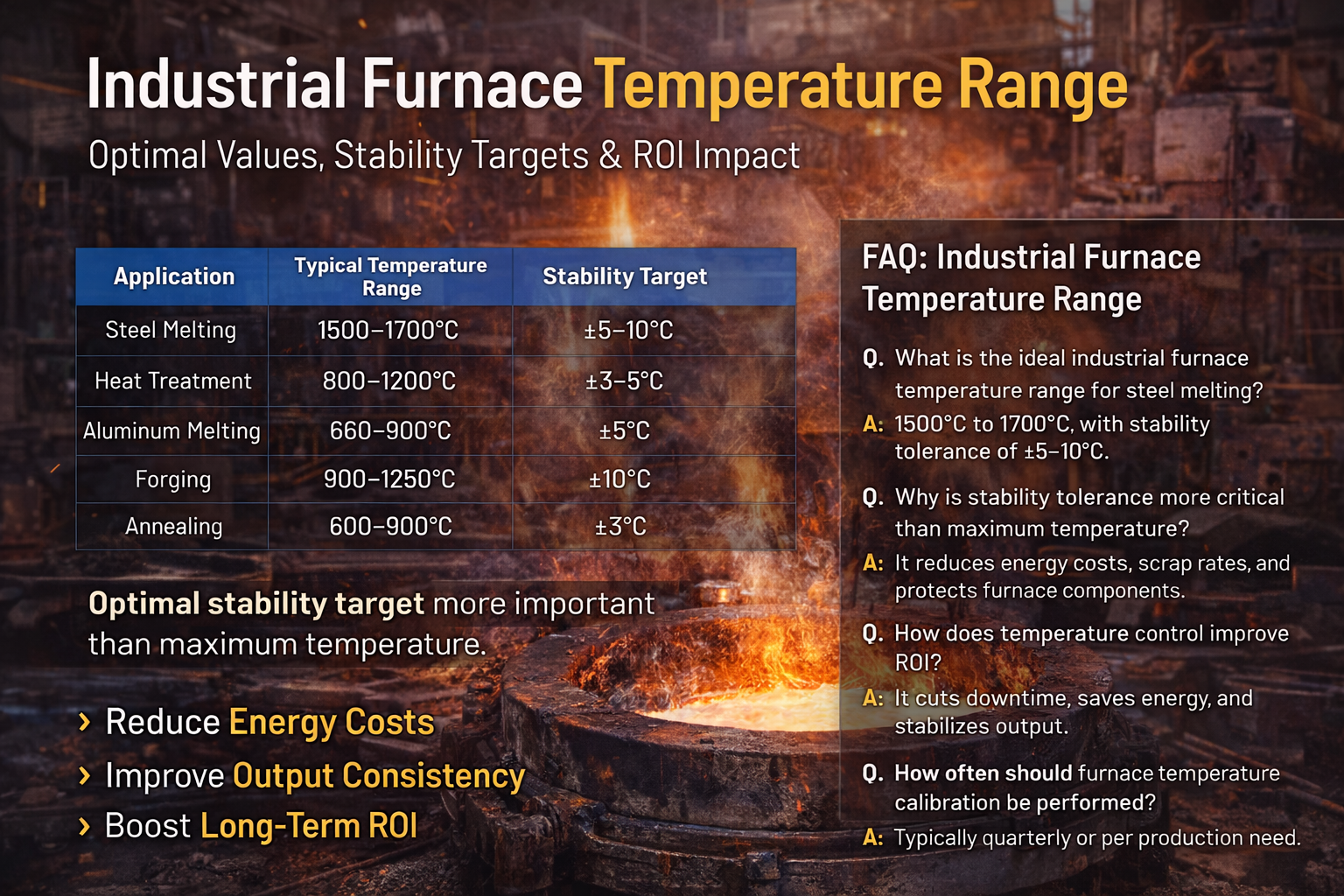
Industrial furnace temperature range refers to the minimum and maximum thermal values within which a furnace operates to complete a specific metallurgical or heat treatment process.
The temperature range alone is not enough.
What truly determines performance is:
-
Stability tolerance (±°C)
-
Heat uniformity
-
Ramp rate control
-
Overheat prevention
For factory owners and plant managers, temperature range determines:
-
Energy cost per ton
-
Cycle time
-
Equipment wear rate
-
Scrap percentage
-
Compliance risk
A furnace capable of 1700°C but fluctuating ±40°C is less profitable than one operating at ±5°C stability.
Precision defines profitability.
2. Standard Industrial Furnace Temperature Range by Application
Below is a practical engineering reference table:
| Application | Typical Temperature Range | Stability Target | Operational Risk if Unstable |
|---|---|---|---|
| Steel Melting | 1500–1700°C | ±5–10°C | Oxidation, inclusion, yield loss |
| Heat Treatment | 800–1200°C | ±3–5°C | Hardness variation |
| Aluminum Melting | 660–900°C | ±5°C | Metal burn-off |
| Forging | 900–1250°C | ±10°C | Surface cracking |
| Annealing | 600–900°C | ±3°C | Grain inconsistency |
Key insight:
The narrower the stability window, the lower the scrap rate.
For steel melting, a stable temperature range improves chemistry control and reduces oxidation losses. That directly affects output consistency and profit margins.
3. Why Stability Tolerance Matters More Than Maximum Temperature
The common misconception is that higher maximum temperature equals better furnace performance.
In practice:
-
Overheating increases oxidation.
-
Wide temperature swings increase refractory stress.
-
Reheating cycles increase electricity consumption.
A controlled industrial furnace temperature range ensures:
-
Consistent metallurgical properties
-
Reduced energy waste
-
Longer lining life
-
Predictable output
For technical directors, temperature tolerance (±3–10°C depending on process) is a more meaningful performance metric than peak temperature capability.
4. How Proper Temperature Range Reduces Energy Cost
Energy cost in industrial furnaces depends on:
-
Ramp efficiency
-
Holding time
-
Insulation quality
-
Control system responsiveness
A properly managed furnace temperature range reduces:
1. Reheating Losses
Precise control avoids overshoot and repeated heating cycles.
2. Idle Heat Waste
Advanced insulation and multi-zone control minimize standby loss.
3. Energy Spikes
Stable power modulation prevents unnecessary load fluctuation.
4. Extended Component Life
Lower thermal stress reduces coil and refractory damage.
For plant owners, this means:
-
Lower kWh per ton
-
More predictable monthly energy bills
-
Faster capital recovery
Energy savings accumulate across years, not days.
5. How Temperature Control Shortens Production Cycles
Production speed depends on ramp rate and uniform heat distribution.
A well-designed industrial furnace operating within its optimal temperature range allows:
-
Faster ramp-up to target temperature
-
Shorter soaking time
-
Reduced cooling delay
-
Improved batch turnover
Cycle efficiency results in:
-
Higher daily output
-
Better equipment utilization
-
Improved cash flow
For general managers evaluating payback period, temperature efficiency is directly linked to throughput growth.
6. Minimizing Downtime Through Heat Management
Most unexpected furnace failures originate from uncontrolled temperature fluctuation.
Common failure causes include:
-
Refractory cracking
-
Coil overheating
-
Power module stress
-
Cooling system imbalance
Stable furnace temperature range control includes:
-
Real-time temperature monitoring
-
Overheat protection systems
-
Predictive maintenance alerts
-
Redundant sensor configuration
Reducing downtime protects:
-
Production schedules
-
Labor efficiency
-
Delivery commitments
Downtime is not only a repair issue. It is a profitability issue.
7. Impact on Metal Purity and Output Consistency
Industrial furnace temperature range directly influences molten metal quality.
In steel applications:
-
Excessive temperature increases oxidation and inclusion.
-
Uneven heating causes chemistry drift.
-
Temperature instability increases scrap.
Precision heat control improves:
-
Alloy homogeneity
-
Surface finish
-
Mechanical property consistency
-
Casting yield
For engineering managers, stable temperature range reduces rework and quality claims.
Consistency builds long-term customer trust.
8. Manufacturer Strength, Global Support & Long-Term Partnership
Temperature range performance depends on design, engineering, and service.
Our capability includes:
-
Dedicated furnace manufacturing facility
-
Experienced thermal engineering team
-
Strict quality control before shipment
-
Proven export project execution
Overseas clients often worry about:
-
Service delays
-
Spare part availability
-
Technical documentation
We address this through:
-
Remote diagnostics support
-
Spare parts logistics planning
-
Structured after-sales system
-
Engineering consultation throughout lifecycle
We are not just equipment sellers.
We act as long-term industrial partners.
9. Addressing Real Buyer Concerns
Investment High but Output Unstable
Specify stability tolerance and uniformity testing before purchase.
Equipment Failure Causing Shutdown Loss
Demand real monitoring systems and spare parts strategy.
Inflated Technical Parameters
Request practical operating data and reference projects.
Actual Capacity Below Expectation
Confirm cycle time and real throughput based on load weight.
Overseas Service Delays
Ensure defined response time agreement.
Long Repair Cycles
Choose modular design for faster maintenance.
Spare Parts Difficult to Source
Standardized components reduce dependency risk.
Financing Risk
Stable operating cost improves cash flow planning.
Uncontrolled Operating Cost
Temperature precision stabilizes energy expenditure.
10. FAQ: Industrial Furnace Temperature Range
Q1: What is the ideal industrial furnace temperature range for steel melting?
Typically 1500–1700°C with stability tolerance within ±5–10°C depending on process design.
Q2: Why is stability more important than maximum temperature?
Stability reduces scrap, saves energy, and protects furnace components.
Q3: How does temperature range affect energy efficiency?
Frequent overheating or reheating increases electricity consumption significantly.
Q4: How often should furnace temperature calibration be performed?
Quarterly or based on production criticality to ensure compliance and consistency.
Q5: Can tighter stability tolerance improve ROI?
Yes. Reduced scrap and energy waste shorten payback period.