
Types of Industrial Furnaces Explained: Efficiency, Performance, and Long-Term ROI
Types of Industrial Furnaces: A Practical Guide for Steel Plants and Metal Processing Factories
Choosing the correct types of industrial furnaces is one of the most important technical and financial decisions in metal processing operations.
For factory owners and steel plant executives, a furnace is not just equipment. It is a core production asset that determines energy cost, production capacity, maintenance requirements, and long-term profitability.
Poor furnace selection can lead to:
-
unstable production output
-
excessive energy consumption
-
frequent downtime
-
expensive maintenance cycles
The right furnace, however, improves production efficiency, metal quality, and long-term return on investment (ROI).
This guide explains the main industrial furnace types, their applications, and how experienced manufacturers evaluate furnace solutions beyond simple technical specifications.
What Is an Industrial Furnace?
An industrial furnace is a high-temperature system designed to heat, melt, refine, or treat metal materials under controlled conditions.
Industrial furnaces are used in:
-
steel plants
-
aluminum smelting facilities
-
foundries
-
metal recycling operations
-
heat treatment plants
Typical operating temperatures range from 500°C to over 1800°C, depending on the process.
The main functions include:
-
metal melting
-
alloy refining
-
heat treatment
-
material sintering
-
forging and reheating
The correct furnace design improves thermal efficiency, process control, and operational safety, all of which directly influence production cost.
Main Types of Industrial Furnaces Used in Metal Processing
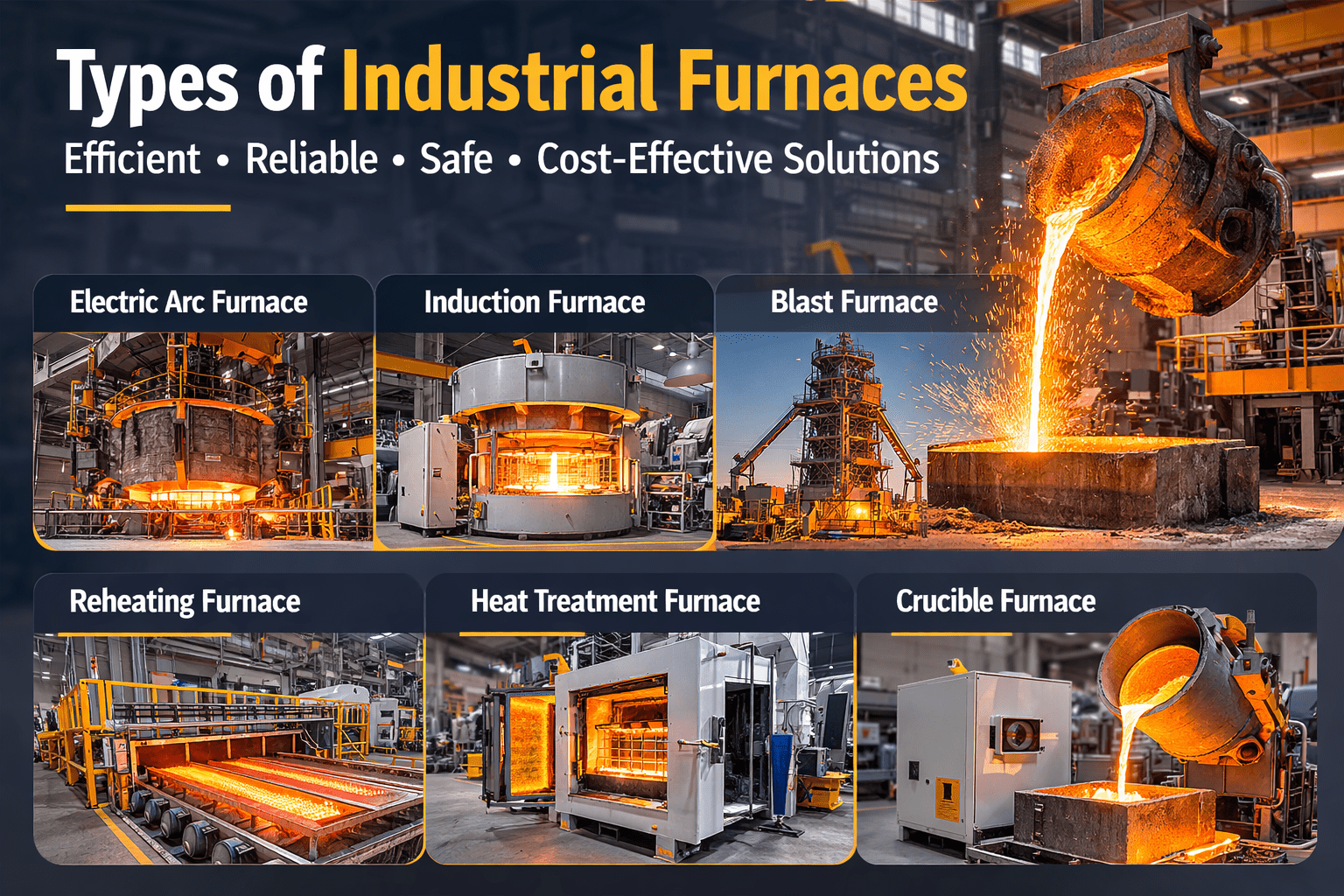
Different metallurgical processes require different furnace technologies. The following are the most widely used types of industrial furnaces in modern metal production.
1. Electric Arc Furnace (EAF)
Electric Arc Furnaces are widely used in steel recycling and secondary steelmaking.
How it works
Electric arcs generated between graphite electrodes and scrap metal create extremely high temperatures capable of melting steel.
Key advantages
-
High melting speed
-
Flexible raw material usage (scrap steel)
-
Lower investment compared with blast furnaces
-
Suitable for mini steel mills
Value for factory owners
Modern EAF systems can significantly reduce production cycle time and allow flexible batch production.
Energy optimization technologies such as oxygen injection and scrap preheating help reduce electricity consumption per ton of steel.
2. Induction Furnace
Induction furnaces are widely used in steel foundries, alloy production, and non-ferrous metal melting.
How it works
Electromagnetic induction generates heat directly inside the metal charge.
Key advantages
-
very high energy efficiency
-
precise temperature control
-
low oxidation loss
-
clean melting process
Why technical directors prefer them
Induction furnaces improve metal purity and chemical consistency, which is critical for specialty steel and alloy production.
They also require less manual operation, improving process control and safety.
3. Blast Furnace
Blast furnaces are used for large-scale iron production from iron ore.
How it works
Iron ore, coke, and limestone are charged into a tall furnace where chemical reactions produce molten iron.
Key advantages
-
very high production capacity
-
suitable for integrated steel plants
-
continuous operation
Industrial perspective
Blast furnaces require significant capital investment, but they deliver unmatched output volume for large steel manufacturers.
Operational stability is essential because unplanned shutdowns can cause major production losses.
4. Reheating Furnace
Reheating furnaces are used in rolling mills to heat steel billets, blooms, or slabs before deformation.
Key functions
-
uniform heating
-
controlled temperature distribution
-
preparation for rolling processes
Benefits for rolling mills
Efficient reheating furnaces reduce:
-
fuel consumption
-
scale formation
-
heating time
Modern walking beam reheating furnaces can improve production throughput while maintaining product quality.
5. Heat Treatment Furnace
Heat treatment furnaces are used to modify the mechanical properties of metal materials.
Common processes include:
-
annealing
-
quenching
-
tempering
-
normalizing
Why they matter
Proper heat treatment improves:
-
strength
-
hardness
-
durability
Automated temperature control ensures consistent product performance across production batches.
6. Crucible Furnace
Crucible furnaces are widely used for small-to-medium scale melting operations.
Typical applications
-
aluminum melting
-
copper alloys
-
precious metals
Advantages
-
relatively simple structure
-
lower investment cost
-
easy operation
However, large-scale factories often prefer induction furnaces for higher efficiency and process control.
How Furnace Selection Impacts Energy Cost and Production Stability
Energy consumption is often the largest operational cost in metal processing.
Well-designed industrial furnaces can reduce energy usage by 10–30% through:
-
advanced insulation materials
-
optimized combustion systems
-
waste heat recovery
-
automated temperature control
Energy-efficient furnaces not only reduce operating cost but also help factories meet environmental compliance requirements.
For many steel plants, improving furnace efficiency can shorten the investment payback period by several years.
Minimizing Downtime and Maintenance Complexity
Unexpected furnace failures are one of the most expensive risks in metal production.
Downtime can result in:
-
lost production output
-
damaged materials
-
contract delays
Experienced furnace manufacturers focus on designs that improve reliability:
-
modular components
-
durable refractory materials
-
simplified maintenance access
-
predictive monitoring systems
These features reduce maintenance complexity and ensure continuous plant operation.
Furnace Design, Engineering Experience, and Real Output Performance
Many buyers have experienced situations where equipment specifications looked impressive but real production performance fell short.
This often happens when furnace suppliers lack practical metallurgical experience.
Factories with strong engineering backgrounds design furnaces based on:
-
real operating data
-
long-term wear patterns
-
metallurgical process requirements
This experience helps ensure that production targets are actually achievable in real factory conditions, not just theoretical calculations.
Global Projects: Service, Spare Parts, and Overseas Support
For international steel plants, furnace performance alone is not enough.
Operational success also depends on after-sales support.
Reliable industrial furnace partners provide:
-
international installation support
-
remote technical diagnostics
-
spare parts supply systems
-
long-term service agreements
Fast access to spare parts and engineering assistance minimizes downtime and protects long-term production capacity.
Frequently Asked Questions (FAQ)
What is the most energy-efficient industrial furnace?
Induction furnaces are generally considered the most energy-efficient for metal melting because they transfer heat directly into the metal.
Which furnace type is best for steel recycling?
Electric Arc Furnaces are the most widely used technology for steel recycling due to their flexibility and high melting speed.
How long does an industrial furnace typically last?
With proper maintenance, industrial furnaces can operate for 10–20 years, depending on usage intensity and refractory maintenance cycles.
How can factories reduce furnace operating costs?
Key strategies include:
-
improving insulation
-
optimizing combustion systems
-
upgrading automation controls
-
implementing waste heat recovery
What should buyers evaluate besides furnace price?
Serious buyers typically evaluate:
-
energy consumption per ton
-
production stability
-
spare parts availability
-
service support capability
-
long-term maintenance cost
Conclusion
Understanding the different types of industrial furnaces is essential for making informed investment decisions in steel and metal processing operations.
The right furnace technology can:
-
reduce energy consumption
-
improve metal quality
-
increase production stability
-
minimize downtime
-
shorten ROI cycles
However, furnace performance depends not only on equipment design but also on the engineering experience, manufacturing capability, and long-term support of the supplier.
Factories that choose furnace partners with proven industrial experience and global service capability consistently achieve better operational results and lower total ownership cost.