

Step Heating for Extrusion Billets | Induction Heating Process
Step Heating Suitable for Extrusion
Induction heating is widely used to prepare billets for extrusion forming. Its principle is no different from the heating principles described earlier. It can also heat large stock, that is, very long billets. When a hot shear is used to cut a long billet into the required number of billets, these billets can still be maintained at the required temperature.
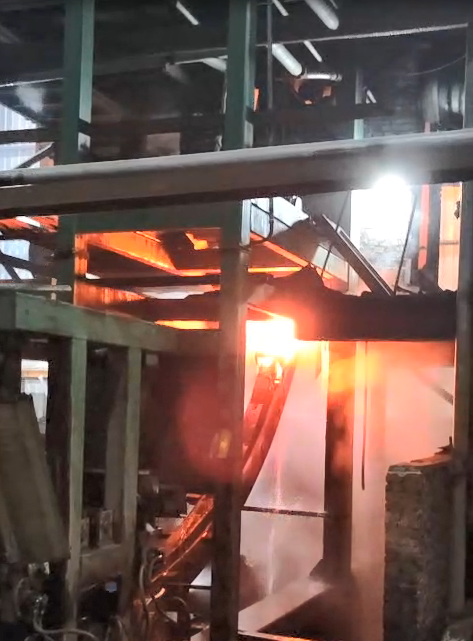
The extrusion forming process requires the billet to have a soft “head” to reduce the starting force of extrusion. Then, heat is generated during extrusion through the die, and mechanical extrusion energy is applied to the billet. Therefore, the ideal method is to apply step heating to the billet, so that the head temperature is 100-120°C higher than the tail temperature.
If this heating method is not used, there may be a risk of dimensional difference and uneven metallurgical quality between the two ends of the finished product. It should be noted that uniformly heated billets may also be used by changing the ram speed during the extrusion cycle, but this method is not ideal.
The design of induction coils for step heating is not discussed in detail here. Since the temperature rise is proportional to billet density, and for non-magnetic materials the power density is proportional to H², the magnetic field must vary with:
√(θ head / θ tail)
where θ is the temperature rise.
For an extrusion temperature of 500°C with a gradual temperature reduction of 100°C, the approximate value is:
√(480 / 380) = 1.1
A more accurate calculation must include the temperature variation of the constant-temperature portion.
As stated in Section 13.10, for a billet with uneven axial temperature distribution, the temperature difference can be completely equalized by the time constant:
(cγl²) / (π²k)
For a 0.3-meter-long aluminum billet at 500°C, it takes 2.5 minutes to equalize the temperature difference. Example 13.7 shows that when the soaking time after heating is 40 seconds, the temperature difference between the two ends of the billet must be 172°C in order to obtain a 100°C temperature difference at the extrusion press.
The calculation can be adjusted according to actual production conditions. Since the above time constant is generally longer than the time required to obtain a uniform temperature across the billet cross-section, a longer soaking cycle is clearly in conflict with the purpose of step heating.