

Resistance to Rapid Cooling and Heating
1. Resistance to Rapid Cooling and Heating
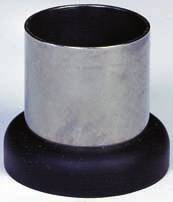
During use, a crucible is repeatedly subjected to heating and cooling. As a result, its volume expands and contracts periodically. At this time, compressive stress is generated inside the crucible. Under the repeated action of this stress, cracks may form. If these cracks continue to develop, the crucible will eventually be damaged.
To extend the service life of the crucible, crucible products are required to have good resistance to rapid cooling and heating. The factors that affect this property include the proportion of crucible sand materials, the compactness of ramming, and the expansion coefficient of the refractory material.
By properly increasing the proportion of medium-sized and coarse sand particles, improving ramming compactness, and selecting refractory materials with a low expansion coefficient, a crucible with better resistance to rapid cooling and heating can be obtained.
Expansion Coefficient and Thermal Shock Resistance of Some Crucible Materials
| Crucible Material | Temperature Range, °C | Expansion Coefficient | Resistance to Rapid Cooling and Heating |
|---|---|---|---|
| MgO | 20-1700 | 15.6 × 10⁻⁶ | Poor |
| MgO·Al₂O₃ | 27-1700 | 8.5 × 10⁻⁶ | Good |
| ZrO₂·SiO₂ | 27-1000 | 4.5 × 10⁻⁶ | Relatively good |
| SiO₂ | 20-1500 | 7.5 × 10⁻⁶ | Relatively good |
2. High-Temperature Strength
During the melting process, the crucible itself is subjected to various forces. These include the impact force of the furnace charge on the crucible, the static pressure of molten steel, the force generated by electromagnetic stirring of molten steel, the stress caused by the temperature difference between the inner and outer walls of the crucible, and the internal stress produced by rapid cooling and heating.
Because of these forces, the crucible must have sufficient strength at both high temperature and room temperature to prevent cracking. The high-temperature strength of a crucible is related to the type of refractory material, forming pressure, sintering process, particle size distribution of the sand material, and other factors.
Therefore, measures must be taken in all aspects to improve the high-temperature strength of the crucible and ensure its normal use.
3. Insulation Performance
The requirement for crucible insulation performance comes from the voltage difference between the molten steel and the induction coil, which is usually from several tens of volts to several hundred volts. Therefore, the crucible material must have a certain level of insulation performance to prevent electrical breakdown.
However, the insulation resistance of the crucible material should not be too high, otherwise it will affect the electrical efficiency of the furnace. When magnetic lines of force pass through the crucible wall, part of the magnetic energy is lost. The lower the resistance of the crucible wall, the smaller the loss when the magnetic field passes through it.
Therefore, while ensuring insulation, the specific electrical resistance of the crucible material should be as low as possible, so that it can both maintain insulation and meet the requirement of improving electrical efficiency.
The specific electrical resistance of commonly used crucible materials decreases as temperature rises. Within the steelmaking temperature range, the specific electrical resistance is generally 10²-10⁴ ohm·cm.
The purity of crucible materials has the most obvious influence on insulation performance and specific electrical resistance. Ferromagnetic substances such as Fe₃O₄ and Fe₂O₃ can significantly reduce both insulation performance and specific electrical resistance. Other components that can form low-melting-point compounds have the same effect.
To ensure safe operation of the crucible at high temperature, insulation performance should be given top priority. Electrical efficiency can be improved by adjusting the thickness of the crucible wall. Therefore, when selecting crucible materials in practice, the purity should be as high as possible to ensure good insulation performance at high temperature.
4. Thermal Conductivity
During the melting process, the temperature difference between the inside and outside of the crucible is very large, reaching as high as 1400-1600°C. According to heat balance calculations, about 10%-15% of the heat is lost outward through the crucible wall. Reducing this part of the heat loss can improve electrical efficiency.
The visible text in the image ends here.