

Heating Elements and Non-Metallic Resistance Heating Materials
Heating Elements and Non-Metallic Resistance Heating Materials
Heating Efficiency in Direct Resistance Heating
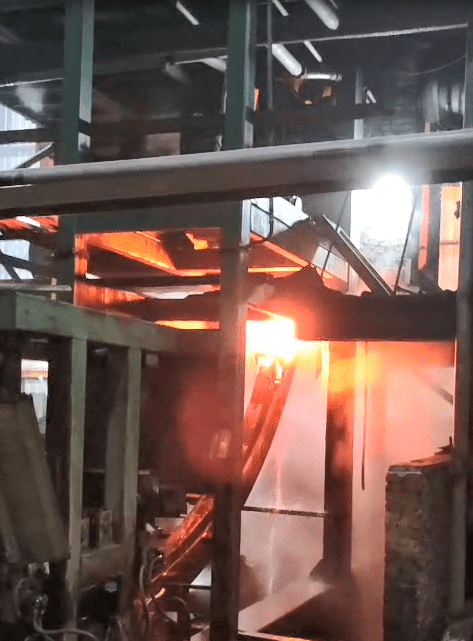
When heating causes the core temperature of a bar to become too high, power consumption also increases, and the corresponding efficiency decreases.
In this case, efficiency refers to the ratio of the “increase in heat content of the bar at the end of heating” to the “heat equivalent of the input electrical energy.”
The following comparison data for resistance heating of mild steel shows the influence of size:
- A bar with a cross section of 60 × 60 mm and a length of 3 m is heated in 117 seconds, with an efficiency of 84%.
- A bar with a cross section of 100 × 100 mm and a length of 3 m is heated in 582 seconds, with an efficiency of 60%.
A typical resistance heating device for bars is usually used to illustrate this type of equipment.
If the cross section of the bar varies along its length, direct resistance heating cannot produce a uniform temperature.
2. Heating Elements
A heating element maintains the required temperature through the balance between energy absorption and heat loss.
The electrical contact point is located outside the furnace. The heating element must pass through the furnace wall, where heat loss is very small. To prevent overheating, the section of the heating element located inside the furnace wall should have a larger cross-sectional area, or it should be made of a material with high electrical conductivity.
3. Non-Metallic Heating Elements
At the high temperature of white heat, refractory materials become electrical conductors. Their electrical conductivity varies with composition, density and temperature.
However, only a very small number of refractory materials are suitable as resistance heating elements, because before use they must first be heated to a high incandescent temperature by another heat source. Even so, some resistance materials are used in practice and must be preheated before operation. These materials include glass and salts.
Granular carbon, such as coke, was one of the earliest non-metallic materials used as heating elements. It is mainly used in pit-type furnaces, also known as soaking pits. In the furnace, it burns slowly and maintains a reducing atmosphere that does not produce oxide scale.
To maintain a sufficient current-carrying cross section, new coke must be added from time to time. Damage to the container and burning of the electrodes that supply current to the carbon particles can both cause failures.
The method of using carbon particles as heating elements has been reapplied in the heating of special steels. In this method, steel is placed in a silicon carbide trough equipped with suitable electrodes, mainly to maintain a reducing or controllable oxidizing atmosphere.
Graphite Heating Elements
In a protective atmosphere, carbon in the form of graphite is an excellent material for making heating elements.
At atmospheric pressure, incandescent graphite does not melt. It sublimates when the temperature exceeds 3600°C. Graphite cannot be rolled, forged or drawn. Heating elements made of graphite are formed by mechanical cutting.
For the reasons described above, graphite heating elements are mainly used where temperatures of 1400°C or higher are required.
A silicon carbide rod with a diameter of 25 mm and a heating section length of 30.5 mm has a resistance of 0.62 ohm at 1040°C. When the resistance of a heating element doubles, it is usually discarded.
Surface Load of Heating Elements
One of the important parameters in resistance heating is the surface load of the heating element. It represents the wattage carried by each square centimeter of heating element surface.
When the arrangement of the heating elements has been determined, this value can be converted into the wattage per square centimeter of furnace wall surface covered by the heating elements.
Because oxidation of heating elements accelerates as temperature rises, the heating element temperature should not be allowed to exceed the furnace temperature significantly in order to extend service life. Therefore, when the furnace temperature is increased, the surface load of the heating element must be reduced accordingly.
Recommended Surface Load and Temperature Relationship
For silicon carbide rod heating elements, the recommended surface load decreases as the operating temperature rises.
The relationship may be summarized as follows:
- Curve 1: air at normal humidity
- Curve 2: hydrogen, cracked ammonia and other hydrogen-containing gases
Influence of Installation Arrangement on Service Life
The service life of a heating element is also affected by its installation arrangement.
The distance between the centers of two rods, and the distance between the rod center and the furnace wall, should not be less than twice the rod diameter. If furnace chamber space is limited, the distance between the rod center and the furnace wall can be reduced to 1.5 times the rod diameter.
These values are determined by experiment and experience. Theoretical calculation is quite complex, because the temperature at different points on the heating element surface is not uniform, leading to different oxidation conditions and blackness values.
If heating elements are arranged too sparsely, heating will be uneven.
The installation method for silicon carbide heating elements is similar to that of horizontal heating elements, because silicon carbide is rigid under furnace-temperature conditions.