
Vacuum Induction Furnace Design
Vacuum Induction Furnace Architecture: Shell Engineering, Coaxial Power Feeds, and Vacuum Systems
Vacuum induction melting (VIM) furnaces require precise integration of robust mechanical structures and complex electrical networks. Every aspect of the furnace body—from the structural steel shell to the vacuum-sealed dynamic electrodes—must handle massive pressure differentials and intense electromagnetic fields while maintaining a clean, airtight refining environment.
1. Furnace Shell Design & Structural Engineering
The furnace body and its auxiliary assemblies comprise the core structural environment needed for charging, ramming, melting, and casting.
Atmospheric Pressure Requirements
Because the entire metallurgical process occurs inside the sealed chamber, the furnace shell must withstand immense compressive forces created by the deep internal vacuum. Ensuring high structural strength is a primary engineering priority.
Shell Wall Configurations
Industrial design variations balance thermal management with furnace capacity:
-
Small-Scale Furnaces: These systems utilize a full double-walled structure across the entire vessel. The outer layer is welded from standard carbon steel plate, while the inner layer uses non-magnetic austenitic stainless steel to prevent stray induction heating. High-velocity cooling water flows continuously between these layers.
-
Large-Scale Furnaces: To optimize manufacturing costs and structural efficiency, large installations use a single-walled steel plate layout as the baseline. Double-walled cooling jackets are restricted to localized high-temperature zones, while the remaining areas are cooled using external networks of surface-mounted water pipes.
2. Internal Components and Moving Assemblies
The intersection where movable sections meet the stationary furnace body, as well as the entry points for auxiliary devices, rely on heavy-duty vacuum-grade rubber gaskets to prevent ambient air leaks.
Internal Configurations
A standard horizontal vacuum induction furnace layout includes several specialized components:
-
Induction coils and crucible support chassis
-
Ingot mold casting mechanisms
-
Material charging chutes
-
Water-cooled coaxial electrodes
External Utilities
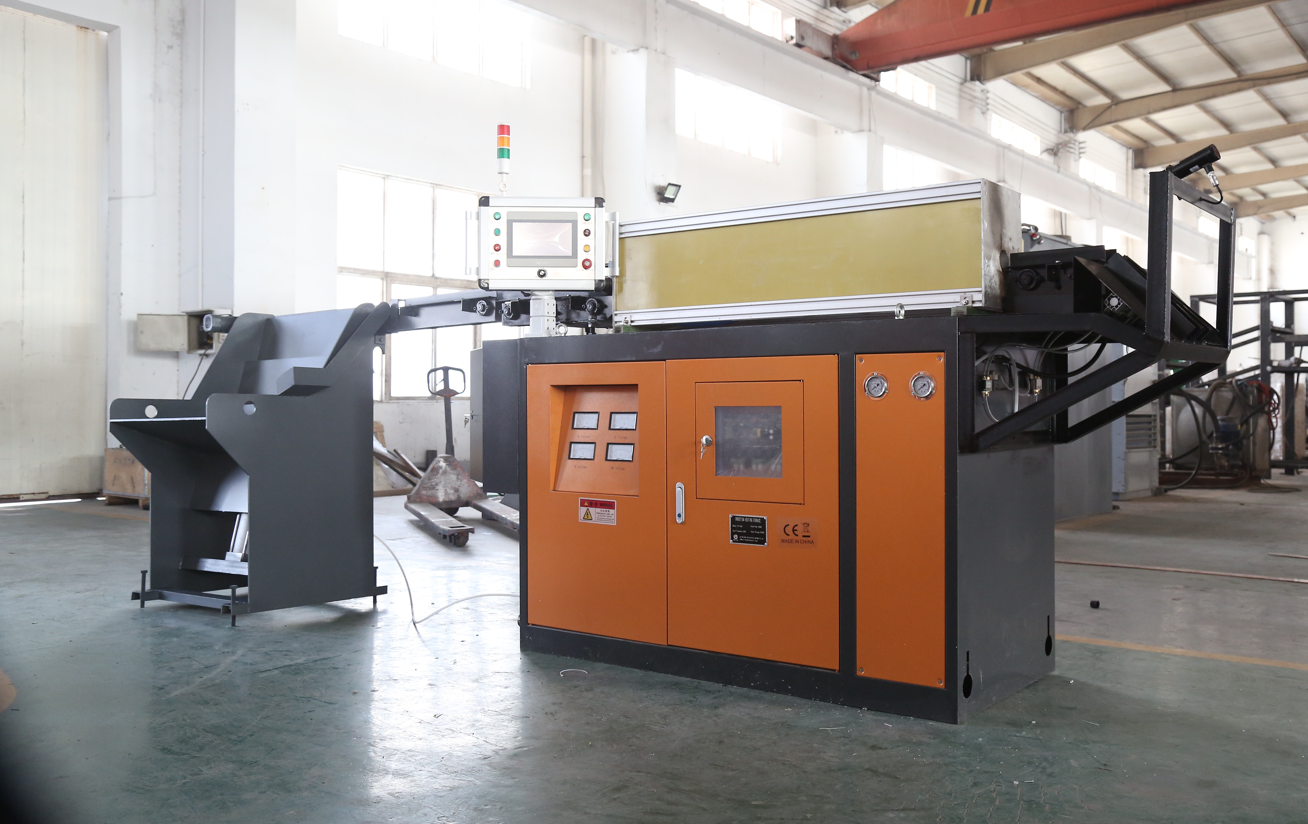
The outer perimeter of the shell houses the mechanical raw material chargers, ramming rods, temperature measurement probes, sampling mechanisms, and optical viewing windows. The high-current power transmission units are mounted directly onto the structural frame.
3. Water-Cooled Coaxial Rotating Electrodes
Delivering high-amperage medium-frequency electrical current and high-pressure cooling water across a moving, vacuum-sealed barrier requires advanced coaxial engineering.
Cross-Sectional Architecture
The structural layout of a standard water-cooled coaxial rotating electrode assembly features concentric electrical circuits designed to minimize magnetic losses:
    [Outer Copper Tube: External Electrode]
         └── [Insulation Layer: Epoxy & Quartz Sand]
                  └── [Inner Copper Tube: Internal Electrode] ── (Dual Core Water Channels)
The assembly uses a concentric, dual-layer design fabricated from high-purity copper tubing:
-
The External Electrode (Outer Layer): Forms the first half of the medium-frequency circuit.
-
The Internal Electrode (Inner Layer): Forms the returning half of the circuit.
-
Dielectric Insulation: The space between the inner and outer copper layers is filled with a poured insulating barrier made of high-strength epoxy resin mixed with quartz sand.
-
Active Thermal Management: Both the internal and external copper conductors feature dedicated internal channels to supply and return cooling water.
Mechanical Details
Referencing the engineering layout of a water-cooled coaxial rotating electrode, the physical assembly consists of eight primary components:
-
External Electrode (Outer conductor)
-
Internal Electrode (Inner conductor)
-
Rotating Handle (For manual tilt control)
-
Trunnion Support Bearing
-
Wilson Vacuum Seal Assembly
-
Primary Vacuum O-Ring Seal
-
Cooling Water Pipe Connector
-
Furnace Shell Wall Interface
Core Functional Objectives
This coaxial configuration achieves three crucial operational goals simultaneously:
-
Efficient Power Delivery: It carries medium-frequency electricity directly to the induction coil. The forward current flows through the outer electrode to the coil and returns via the inner electrode, creating a balanced, self-canceling loop that eliminates stray eddy-current heating in the steel furnace shell.
-
Coil Thermal Protection: It supplies a continuous stream of low-temperature cooling water to protect the induction coil loops during high-temperature heats.
-
Crucible Dynamic Tilting: It serves as the structural rotation axis (trunnion), allowing the internal crucible to tilt smoothly for casting operations while maintaining a tight vacuum seal.
4. High-Vacuum System Configurations
The refining vacuum inside industrial furnaces is typically maintained within a target operational range of $10^{-2}$ to $10^{-3}$ Torr. Because large-capacity furnaces have larger inner surface areas and higher outgassing loads, they generally run at slightly higher pressures (lower vacuum levels) than small-scale benchtop units. Maintaining these deep vacuums requires custom-configured vacuum pumping skids tailored to the outgassing volume of the furnace.
Core Components of a VIM Vacuum Skid
A complete vacuum system is an integrated network consisting of:
-
The Vacuum Chamber: The primary furnace shell vessel.
-
Pumping Mechanical Skids: Integrated combinations of roughing pumps, roots blowers, and high-vacuum oil diffusion or turbomolecular pumps.
-
Interconnecting Manifolds: High-conductance vacuum piping networks.
-
Isolation Valves: Heavy-duty vacuum gate valves and butterfly valves.
-
Measurement Gauges: Vacuum gauges and monitoring sensors.
Primary Performance Metrics
| Vacuum Parameter | Technical Definition | Engineering Significance |
| Operational Vacuum | The absolute pressure maintained during active melting, refining, and pouring phases. | Divided into melting, refining, and casting stages; serves as the primary indicator of system purity. |
| Ultimate Vacuum | The lowest achievable pressure inside a clean, empty furnace chamber at ambient room temperature. | Validates the maximum volumetric displacement capacity of the pumps and verifies the absence of structural leaks. |
| Volumetric Pumping Speed | The volume of gas evacuated by the pumping skid per unit of time ($\text{m}^3/\text{s}$ or $\text{L}/\text{s}$). | Higher pumping speeds minimize pump-down times and improve processing efficiency. |
| Pressure Rise Rate | The rate of pressure increase inside the isolated chamber over a specific time window after shutting off the pumps. | Measures real-time atmospheric micro-leakage and internal material outgassing rates. |