
Custom Industrial Furnace: Engineered Heat Treatment Solutions for Modern Industry
Custom Industrial Furnace
A custom industrial furnace is a thermally engineered heating system designed specifically to meet the unique process requirements of a manufacturing facility.
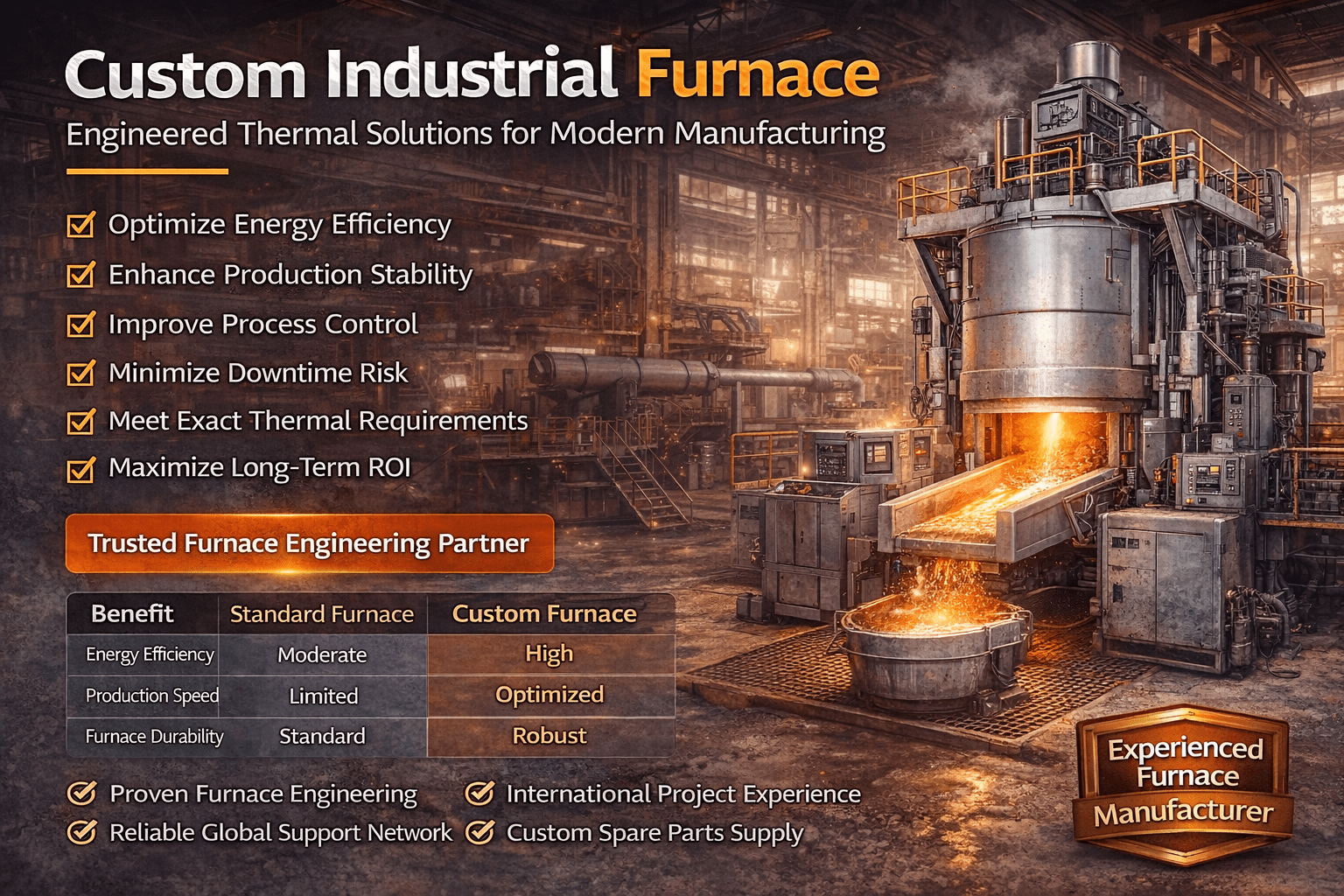
Unlike standard furnaces, custom furnace systems are developed based on precise production conditions such as:
-
material type
-
processing temperature
-
production capacity
-
plant layout
-
automation requirements
Custom industrial furnaces are widely used in industries including:
-
steel production
-
aluminum processing
-
metal heat treatment
-
forging and casting
-
aerospace materials
-
automotive manufacturing
For factory owners, plant managers, and engineering directors, selecting a custom furnace solution ensures greater process reliability, optimized energy consumption, and long-term operational stability.
The right furnace design directly affects product quality, production efficiency, and investment return.
Key Design Factors in Custom Furnace Engineering
Designing a custom industrial furnace requires deep engineering expertise and practical industry experience.
Several critical factors must be carefully evaluated.
Thermal Efficiency
Furnace insulation, burner design, and airflow management determine how efficiently heat energy is utilized.
Efficient systems reduce energy consumption while maintaining stable processing temperatures.
Material Compatibility
Different metals and materials require specific heating environments.
For example:
-
steel heat treatment requires precise temperature ramping
-
aluminum melting requires contamination control
-
specialty alloys demand uniform heat distribution
Custom furnace design ensures the correct heating technology is applied.
Process Automation
Modern industrial furnaces increasingly rely on automated systems for:
-
temperature monitoring
-
process control
-
safety protection
-
performance diagnostics
Automation reduces human error and improves operational consistency.
Energy Efficiency and Operating Cost Reduction
Energy consumption is often one of the largest operating expenses in industrial manufacturing.
A well-engineered custom furnace can significantly reduce long-term energy costs.
Advanced Insulation Systems
Modern refractory and insulation materials dramatically reduce heat loss.
This improves overall thermal efficiency.
Optimized Burner or Heating Systems
Precise combustion control or electrical power management ensures optimal energy usage.
Intelligent Heat Recovery
Some custom furnace systems incorporate waste heat recovery technologies that recycle thermal energy back into the production process.
This approach reduces total energy consumption per production cycle.
Production Stability and Process Control
Industrial production requires consistent output quality.
Any temperature fluctuation or furnace malfunction can cause production losses.
Custom furnace systems improve stability through:
-
precision temperature control
-
uniform heat distribution
-
automated monitoring systems
These capabilities ensure reliable thermal conditions throughout the entire production cycle.
For industries such as aerospace, automotive, and high-grade steel manufacturing, temperature accuracy directly determines product quality.
Minimizing Downtime Through Intelligent Furnace Design
Unexpected equipment failures can disrupt production schedules and cause financial losses.
Custom furnace systems are designed to minimize downtime risks.
Modular System Architecture
Many modern furnaces use modular components that allow quick replacement without shutting down the entire system.
Predictive Maintenance Monitoring
Advanced sensors monitor:
-
burner performance
-
heating element conditions
-
cooling systems
-
structural integrity
This enables maintenance teams to address potential issues before failures occur.
Simplified Maintenance Design
Custom furnaces are engineered with maintenance access points that reduce service time and simplify component replacement.
The Importance of Choosing an Experienced Furnace Manufacturer
Industrial furnace procurement involves significant capital investment.
Selecting the wrong supplier can create long-term operational risks.
Common issues faced by industrial buyers include:
-
inflated furnace capacity claims
-
unstable temperature performance
-
delayed installation support
-
limited spare parts availability
An experienced furnace manufacturer provides much more than equipment.
Reliable suppliers deliver:
Proven Engineering Expertise
Extensive experience in furnace design ensures reliable performance under demanding industrial conditions.
Global Export Capability
International projects require compliance with multiple electrical, safety, and environmental standards.
Overseas Technical Support
Responsive engineering teams provide installation guidance and rapid troubleshooting support.
Spare Parts Logistics
Stable spare parts supply ensures uninterrupted furnace operation over many years.
Professional furnace manufacturers focus on building long-term partnerships with industrial clients rather than short-term equipment sales.
Frequently Asked Questions
What is a custom industrial furnace?
A custom industrial furnace is a heating system engineered specifically to meet the production requirements of a particular manufacturing process.
Why choose a custom furnace instead of a standard furnace?
Custom furnaces are optimized for the plant’s material, capacity, and temperature requirements, resulting in better efficiency and production stability.
How long does an industrial furnace typically last?
With proper maintenance, most industrial furnaces operate effectively for 15–20 years or longer.
What industries use custom industrial furnaces?
Industries including steel manufacturing, aluminum processing, automotive production, aerospace materials, and metal heat treatment rely on custom furnace solutions.
How does a custom furnace reduce operating costs?
By optimizing thermal efficiency, automation, and process control, custom furnaces reduce energy consumption, improve production speed, and minimize downtime.
Conclusion
A custom industrial furnace is not simply a piece of heating equipment—it is a critical component of modern industrial production systems.
For plant owners and engineering managers, the right furnace solution delivers:
-
stable and predictable production output
-
improved energy efficiency
-
better process control
-
reduced maintenance complexity
-
long-term operational reliability
Most importantly, selecting an experienced furnace engineering partner ensures that the system is designed, installed, and supported throughout its entire lifecycle.
In industrial manufacturing, the most successful companies view furnace suppliers not merely as equipment vendors but as trusted engineering partners committed to long-term operational success.