
Ferroalloys for Steelmaking and Induction Furnace Melting
Ferroalloys for Steelmaking and Induction Furnace Melting
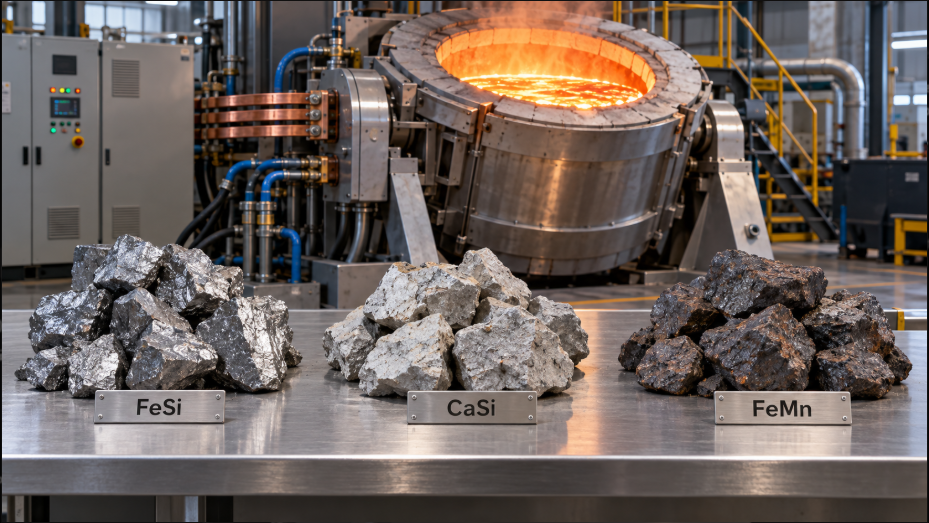
Ferroalloys and related alloying materials supply silicon, manganese and other elements during steelmaking. They also serve as deoxidizers. When preparing an induction furnace charge, their carbon, phosphorus, sulfur and gas contents must be considered alongside the required alloying elements.
1. Ferrosilicon
The reduction reactions associated with ferrosilicon production include:
SiO₂ + 2C → Si + 2CO
Fe₂O₃ + 3C → 2Fe + 3CO
Common ferrosilicon grades and their chemical compositions are listed in Table 4-23.
Table 4-23. Ferrosilicon Grades and Chemical Composition — GB 2272-80
All values are percentages. Silicon is given as a range; other listed elements are maximum contents.
| Grade | Si | Mn | Cr | Al | Ca | P | S |
|---|---|---|---|---|---|---|---|
| Si90Al1.5 | 87.0–95.0 | 0.4 | 0.2 | 1.5 | 1.5 | 0.04 | 0.02 |
| Si90Al3 | 87.0–95.0 | 0.4 | 0.2 | 3.0 | 1.5 | 0.04 | 0.02 |
| Si75Al1 | 72.0–80.0 | 0.5 | 0.5 | 1.0 | 1.0 | 0.04 | 0.02 |
| Si75Al1.5 | 72.0–80.0 | 0.5 | 0.5 | 1.5 | 1.0 | 0.04 | 0.02 |
| Si75 | 72.0–80.0 | 0.5 | 0.5 | — | — | 0.04 | 0.02 |
| Si65 | 65.0 to <72.0 | 0.6 | 0.5 | — | — | 0.04 | 0.02 |
| Si45 | 40.0–47.0 | 0.7 | 0.5 | — | — | 0.04 | 0.02 |
The aluminum– and calcium-bearing grades Si90Al1.5, Si90Al3, Si75Al1 and Si75Al1.5 are mainly used as deoxidizers. Si45 and Si65 can be used to introduce silicon into the melt.
For silicon-bearing spring steels and electrical steels, the source specifies ferrosilicon with the lowest practical aluminum content. Aluminum can promote flake graphite formation in spring steel, reducing its properties. Residual aluminum can also increase eddy-current losses in silicon electrical steel.
Ferrosilicon should be stored in a dry environment. Moisture can decompose aluminum phosphide present in the alloy and release highly toxic phosphine gas. The source expresses the reaction as:
2AlP + 3H₂O → 2PH₃↑ + Al₂O₃
2. Calcium–Silicon Alloy
Calcium–silicon alloy typically contains 24%–31% Ca, 55%–65% Si and less than 5.0% Fe. Material containing approximately 90% combined Si and Ca has a melting range of about 980–1,200°C and a density of approximately 2.2 g/cm³.
It is produced in an electric furnace using lime and quartz sand, with coke as the reducing agent. The reactions are:
CaO + 3C → CaC₂ + CO↑
CaC₂ + SiO₂ → CaSi + 2CO↑
Combining these reactions gives:
CaO + SiO₂ + 3C → CaSi + 3CO↑
Table 4-24. Calcium–Silicon Alloy Grades and Chemical Composition — GB 3419-82
All values are percentages. Calcium values are minimums, silicon is given as a range, and other elements are maximums.
| Grade | Ca, Min. | Si | C, Max. | Al, Max. | P, Max. | S, Max. |
|---|---|---|---|---|---|---|
| Ca31Si60 | 31 | 55–65 | 0.8 | 2.4 | 0.04 | 0.06 |
| Ca28Si60 | 28 | 55–65 | 0.8 | 2.4 | 0.04 | 0.06 |
| Ca24Si60 | 24 | 55–65 | 0.8 | 2.5 | 0.04 | 0.04 |
In addition to these impurities, the source reports oxygen at approximately 500 ppm, hydrogen at 45–180 ppm and nitrogen at approximately 200 ppm.
Calcium has a strong affinity for oxygen. Calcium–silicon alloy should therefore not remain exposed to the atmosphere for extended periods. Oxidation consumes calcium and reduces the alloy’s deoxidizing capacity before it reaches the steel melting furnace.
3. Manganese and Manganese Alloys
Manganese is an alloying element in steel and helps counteract the harmful effects of sulfur. Together with silicon and aluminum, it can also serve as a deoxidizing element.
Manganese-bearing charge materials include metallic manganese, electrolytic manganese, ferromanganese and silicomanganese.
Metallic Manganese
Metallic manganese is silvery-white and brittle. The source gives a melting point of 1,244°C, a boiling point of 2,150°C and a density of 7.43 g/cm³.
It can be produced by reducing manganese oxide concentrate with silicon or aluminum:
3MnO + 2Al → 3Mn + Al₂O₃
2MnO + Si → 2Mn + SiO₂
These reactions take place in an electric furnace. Residual silicon and aluminum enter the manganese melt. Silica in the concentrate may also be reduced by aluminum, introducing additional silicon. Metallic manganese consequently contains impurities such as Si and Al.
Table 4-25. Metallic Manganese Grades and Chemical Composition
All values are percentages. Manganese values are minimums; other elements are maximums.
| Grade | Mn | Si | P | Al | Fe | C | S |
|---|---|---|---|---|---|---|---|
| JMn1 | 96 | 0.5 | 0.05 | 0.06 | 2.5 | 0.10 | 0.05 |
| JMn2 | 95 | 0.8 | 0.055 | 0.08 | 3.0 | 0.15 | 0.055 |
| JMn3 | 93 | 1.8 | 0.06 | 0.10 | 4.5 | 0.20 | 0.06 |
JMn1 and JMn2 are mainly used for melting high-manganese alloy steels. JMn3 can be used for high-manganese cast steels and low-alloy steels. Metallic manganese can also be used as a deoxidizer.
Electrolytic Manganese
Electrolytic manganese is deposited on the cathode by electrolyzing aqueous manganese sulfate or manganese chloride solutions with an insoluble anode. It has a high purity and relatively low levels of metallic impurities.
However, electrolytic manganese may contain comparatively high sulfur and gas contents. When it is used to melt high-manganese alloys, these constituents can contribute to gas porosity in ingots or castings and poor hot ductility.
Different fluxes can be used to refine electrolytic manganese in an induction furnace to reduce sulfur and gas contents.
Table 4-26. Electrolytic Manganese Grades and Chemical Composition — GB 3418-82
All values are percentages. Manganese values are minimums; other entries are maximums.
| Grade | Mn | C | S | P | Se + Si + Fe | Total Impurities |
|---|---|---|---|---|---|---|
| DJMn99.7 | 99.7 | 0.04 | 0.05 | 0.005 | 0.205 | 0.3 |
| DJMn99.5 | 99.5 | 0.08 | 0.10 | 0.10 | 0.310 | 0.5 |
The refining results in Table 4-27 show reductions in sulfur and total gas content with each of the listed fluxes.
When borax is used, boron pickup must be considered. Lithium fluoride produces substantial volatilization during refining, creating an environmental concern. Cryolite gave the best overall result in the comparison reported in the source.
Table 4-27. Effect of Different Fluxes on Electrolytic Manganese Refining
Composition values are percentages. Total gas content is expressed in cm³ per 100 g. Gas headings follow the original table.
| Refining Flux | C | S | O₂ | H₂ | N₂ | Total Gas |
|---|---|---|---|---|---|---|
| Before refining | 0.07 | 0.104 | 0.09 | 0.055 | 0.076 | 625 |
| Borax | 0.05 | 0.023 | 0.06 | 0.008 | 0.007 | 105 |
| Barium chloride | 0.055 | 0.03 | 0.65 | 0.008 | 0.0075 | 112 |
| Cryolite | 0.03 | 0.025 | 0.022 | 0.003 | 0.0065 | 96 |
| Lithium fluoride | 0.035 | 0.018 | 0.015 | 0.010 | 0.0075 | 120 |
Electrolytic manganese is mainly used for melting precision alloys, electrical resistance alloys and other specialty alloys.
4. Ferromanganese
Ferromanganese is an iron alloy containing approximately 65%–80% manganese. It is used as a deoxidizer and alloying addition in steelmaking.
The source describes three categories: low-carbon, medium-carbon and high-carbon ferromanganese. Their chemical compositions are referenced in Table 4-28, which is not included in the supplied images.
Low-Carbon Ferromanganese
Low-carbon ferromanganese is produced in an electric furnace by reducing manganese concentrate with silicomanganese containing approximately 60%–65% Mn and 15%–20% Si. The concentrate also contains impurities such as SiO₂ and Fe₂O₃.
The reactions given in the source are:
MnO₂ + Si → Mn + SiO₂
2Fe₂O₃ + 3Si → 4Fe + 3SiO₂
The resulting manganese and iron combine to form ferromanganese.
Low-carbon ferromanganese has a melting point of approximately 1,380°C and is mainly used for producing low-alloy steels and high-manganese steels. Phosphorus content is a major factor limiting its use.
It also contains gases. The source reports approximately 10–50 ppm H₂ and 300–400 ppm N₂.
Medium-Carbon Ferromanganese
Medium-carbon ferromanganese is produced by reducing manganese concentrate with ferrosilicon in an electric furnace.
Material containing 1.0%–1.5% carbon has a melting point of approximately 1,350°C. It is mainly used in low-alloy steel production and as a deoxidizer.
High-Carbon Ferromanganese
High-carbon ferromanganese is produced in an electric furnace by reducing manganese oxides in a manganese-rich slag with carbon. The reactions proceed through a manganese carbide intermediate:
3MnO + 4C → Mn₃C + 3CO↑
Mn₃C + MnO → 4Mn + CO↑
Silica and iron oxide in the slag are also reduced by carbon, allowing silicon and iron to enter the ferromanganese.
High-carbon ferromanganese has a melting range of approximately 1,250–1,300°C. The visible text identifies high-carbon steel production as an application; the remainder of that sentence continues beyond the supplied page.