
Turnkey Foundry Project Solutions: Strategic EPC Guide 2026
Turnkey Foundry Project Solutions: The Strategic Blueprint for Modern Metallurgical Excellence
Turnkey foundry project solutions are comprehensive, end-to-end industrial services where a single engineering partner assumes full responsibility for the design, procurement, construction (EPC), and commissioning of a metal casting facility. Unlike fragmented procurement models, a turnkey solution provides a “ready-to-operate” plant, encompassing everything from initial feasibility studies and metallurgical process design to the installation of induction furnaces, automated molding lines, and environmental control systems. For factory owners and technical directors, this model eliminates the “integration risk” associated with managing multiple vendors, ensuring that the final output meets specific capacity, quality, and energy efficiency benchmarks from day one.
In the modern industrial landscape, shifting to a turnkey model is driven by the need for Total Cost of Ownership (TCO) optimization. Recent industrial data indicates that foundries built under a turnkey EPC contract realize a 15% to 20% faster time-to-market and a 12% reduction in unforeseen CapEx overruns compared to self-managed projects. By centralizing accountability, turnkey providers allow stakeholders to focus on market expansion while the engineering experts focus on the “melt-to-mold” synchronization.
1. The Strategic Value of EPC in Foundry Engineering
When a steel mill or manufacturing group invests in a new facility, they face a choice between fragmented procurement and turnkey foundry project solutions. The latter is an Engineering, Procurement, and Construction (EPC) model that safeguards the investor’s capital.
The primary advantage is risk mitigation. In a fragmented model, if the automated pouring system does not sync with the molding line, vendors often blame each other’s software. In a turnkey solution, the responsibility lies solely with the lead partner, ensuring a seamless digital and mechanical handshake.
2. Phase-by-Phase Lifecycle of a Turnkey Foundry Project
A successful turnkey implementation follows a rigorous sequence designed to transform a greenfield site or an empty brownfield warehouse into a high-output profit center.
Phase 1: Conceptual Design and Feasibility
The project begins with a metallurgical audit. The partner determines the optimal melt rate, alloy variety, and cooling curves. This stage defines the Annual Production Capacity (e.g., 50,000 tons of ductile iron) and sets the baseline for energy consumption targets.
Phase 2: Process Engineering and Layout Optimization
Using 3D CAD and flow simulation software, engineers design the plant layout. The goal is to minimize the “internal logistics” distance—the physical path the molten metal, sand, and finished castings take through the factory. Efficient layouts can reduce labor costs by up to 18%.
Phase 3: Procurement and Fabrication
The turnkey provider manufactures the core equipment—such as the induction furnace industrial units and sand reclamation systems—while sourcing standardized components (PLCs, motors) from global brands like Siemens or Schneider to ensure local spare parts availability.
Phase 4: On-site Installation and Commissioning
The most critical stage. Technical teams manage the civil works, electrical integration, and mechanical assembly. This is followed by “Dry Runs” (mechanical testing) and “Wet Runs” (actual melting and pouring) to verify technical parameters.
3. Core Technical Components of a Turnkey Solution
A comprehensive turnkey foundry project solution integrates several high-tech modules into a singular ecosystem. Understanding these components is vital for technical directors assessing a proposal.
High-Efficiency Melting Systems
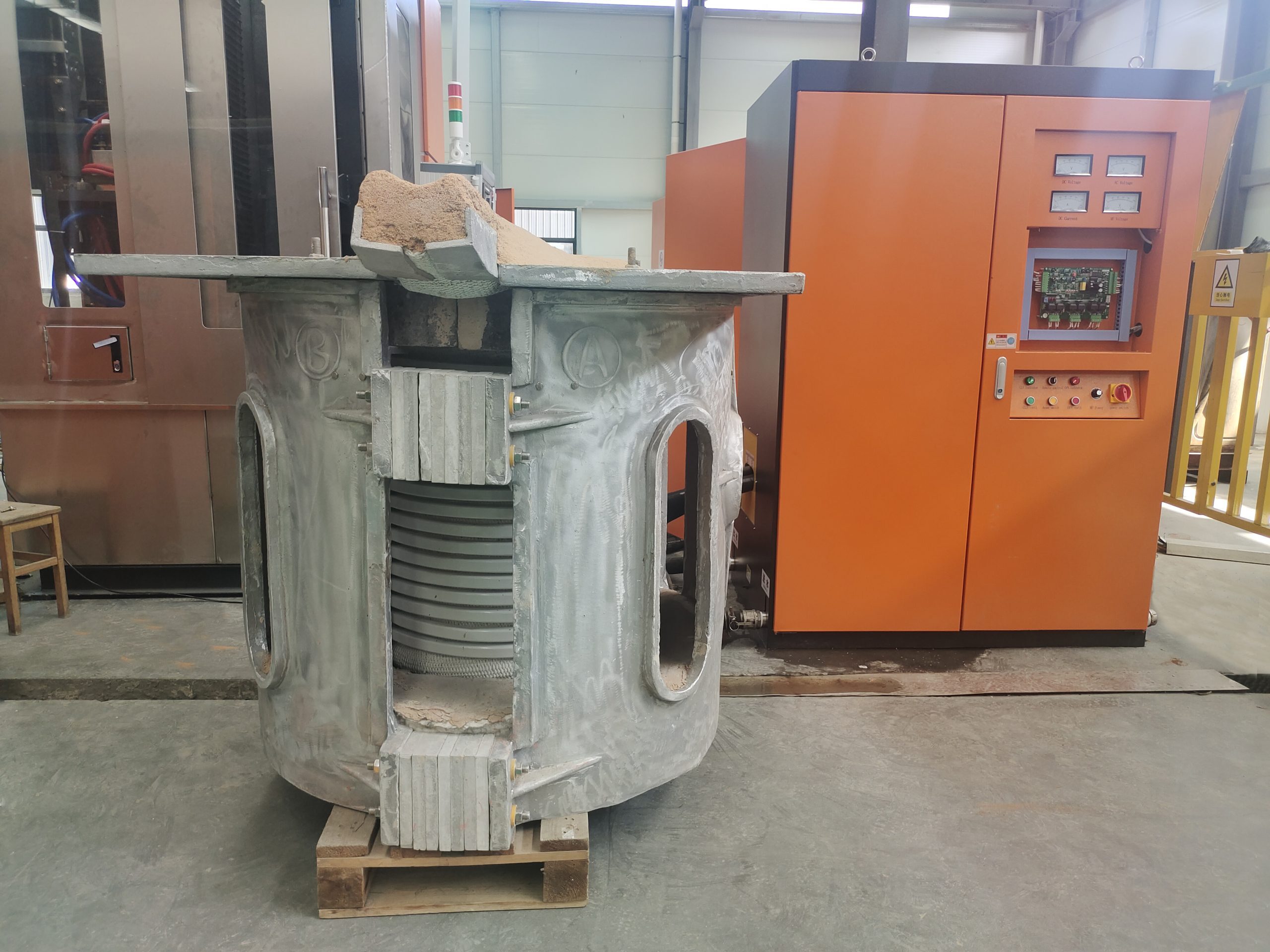
The heart of the plant is the induction furnace. Modern turnkey projects prioritize IGBT-driven power supplies which offer a constant power factor of 0.96 or higher. This prevents utility penalties and reduces the “kWh per ton” cost, directly impacting the plant’s EBITDA.
Automated Molding and Pouring
To ensure consistency and safety, automated lines replace manual labor.
-
Green Sand Molding: High-speed horizontal or vertical lines.
-
No-Bake Systems: Ideal for large, complex castings.
-
Automated Pouring: Laser-guided systems that reduce spills and ensure precise weight in every mold.
Sand Reclamation and Environmental Control
Environmental compliance is no longer optional. Turnkey solutions include dust extraction and waste sand reclamation systems. Modern reclamation can recycle 90% to 95% of foundry sand, drastically reducing raw material costs and landfill fees.
4. Industry 4.0: The Rise of the Smart Foundry
Modern turnkey foundry project solutions now incorporate “Foundry 4.0” features. These are not just “bells and whistles”; they are data-driven tools that minimize the cost of quality.
-
Real-time Melt Analysis: Sensors communicate with the furnace to adjust power levels based on the chemical composition of the scrap.
-
Predictive Maintenance: Vibration and heat sensors on gearboxes and motors flag potential failures before they cause a production halt.
-
Digital Twins: A virtual model of the foundry allows managers to simulate “what-if” scenarios (e.g., increasing output by 10%) without risking actual equipment.
By integrating these features into the turnkey package, the provider ensures the factory is future-proofed against rising labor costs and evolving environmental regulations.
5. Economic Impact: Calculating ROI and Payback Period
From the perspective of a factory owner, the turnkey foundry project solution must be financially justifiable. The investment recovery is typically driven by three “Profit Levers.”
The Three Profit Levers
-
Energy Efficiency: Reducing consumption from 600 kWh/t to 520 kWh/t. In a 10,000-ton plant, this saves roughly $80,000 annually (depending on local rates).
-
Yield Recovery: Advanced pouring and molding reduce “scrap rates” from 5% to 1.5%. Recovering 3.5% of production adds significant revenue with zero additional material cost.
-
Labor Optimization: Automation allows a plant that previously required 50 workers to operate with 12, significantly lowering the “cost per casting.”
Case Study Snapshot: A mid-sized foundry in Southeast Asia transitioned to a turnkey automated line. Within 18 months, their rejection rate dropped by 65%, and the energy savings alone covered the interest on their capital loan.
6. Global Logistics and Overseas Support Capability
A turnkey provider’s value is tested by their ability to support the project after the contract is signed. For international buyers, “Export Pedigree” is essential.
The Support Infrastructure
-
Customs and Shipping: Managing 20+ containers of heavy machinery requires specialized logistics to avoid port demurrage fees.
-
Remote Technical Access: Through secure industrial VPNs, engineers can “remote-in” to the plant’s PLC to troubleshoot software issues in real-time.
-
Local Training: The turnkey partner must remain on-site for 4–8 weeks post-commissioning to train local staff on maintenance and safety protocols.
This “Global-Local” approach ensures that even if the manufacturer is in China and the plant is in Mexico, the facility operates with “local-speed” responsiveness.
7. Strategic Advice for Shortlisting Turnkey Partners
Choosing a partner for a turnkey foundry project solution should not be based solely on the lowest bid. Use the following criteria for your technical audit:
-
Engineering Pedigree: Do they have 15+ years of experience? Ask for a list of successfully commissioned plants in your specific alloy (e.g., steel vs. aluminum).
-
Component Standards: Do they use global brands (Siemens, ABB, Schneider)? This ensures your facility isn’t crippled by “proprietary” parts that take weeks to ship.
-
In-House Manufacturing: A partner who manufactures their own furnaces and molding lines has better control over the integration than a “middle-man” trading company.
-
TCO Guarantee: Ask for a written guarantee on energy consumption (kWh/ton) and melt loss percentages.
FAQ Section
Q1: What is the typical timeline for a turnkey foundry project?
Answer: Depending on the capacity and complexity, a greenfield turnkey project usually takes 10 to 14 months from initial design approval to the first successful pour.
Q2: Is a turnkey solution more expensive than buying machines separately?
Answer: The initial “sticker price” of the equipment may be slightly higher, but the Total Project Cost is usually lower. You save on third-party engineering fees, installation mistakes, and the high cost of production delays caused by vendor misalignment.
Q3: Does a turnkey solution include the building’s civil construction?
Answer: Typically, the turnkey provider provides the Civil Engineering Drawings (pit designs, load-bearing specs), while the local client handles the actual concrete and steel building construction through a local contractor to save on costs.
Q4: Can an existing foundry be upgraded using a turnkey approach?
Answer: Yes. This is known as a Brownfield Modernization. The partner audits the existing layout and integrates new automated modules into the current workflow, often in phases to minimize production downtime.
Q5: What happens if a critical component fails after the warranty?
Answer: Reliable turnkey partners use Standardized Global Components. This means you can often buy a replacement sensor or breaker from a local industrial supplier. For specialized parts (like induction coils), the partner should provide a “24-Month Spares Kit” as part of the initial shipment.