Luoyang HongtengIntermediate frequency induction furnace
The Physical Properties of Solid Aluminum: A Technical Guide Aluminum is a light metal defined by its low density and high versatility. The density of solid pure aluminum is approximately 2.7 g/cm³, roughly one-third that of iron or copper. While density varies slightly with purity, the most significant industrial advantages of aluminum lie in its electrical and thermal performance. 1. Electrical Conductivity and Resistivity Pure aluminum is an exceptional conductor of electricity. For high-purity aluminum (99.990%), the physical specifications at 20°C are as follows: Resistivity ($\rho$): $2.6548 \times 10^{-8} \, \Omega \cdot \text{m}$ Volume Conductivity: 64.94% IACS (International Annealed Copper Standard). Electrical Grade Aluminum: Typically maintains a volume conductivity of at least 62% IACS. Sensitivity to Purity and Temperature Aluminum’s electrical performance is highly sensitive to its environment and composition: Temperature: As temperature rises, resistivity increases and conductivity decreases. Purity: Conductivity drops sharply as impurities increase. In the melting and casting process for electrical-grade aluminum, maintaining high purity is critical to meeting performance standards. 2. Aluminum vs. Copper: The Efficiency Comparison While aluminum’s conductivity is only about 65% of copper’s, its significantly lower density makes it the superior choice for power transmission in terms of weight-to-performance. Property Pure Aluminum Pure...
Furnace Temperature Control and Aluminum Alloy Batching IV. Temperature Control So far, we have discussed how to avoid damage caused by creep due to excessive stress and repeated bending during design. We have also discussed the influence of design work on local overheating. In the discussion, the temperature problem of those parts where serious damage to the heat exchanger is caused by overheating has not been mentioned. The level of this temperature depends on the properties of the heat exchanger metal material. These properties include mechanical strength, elongation at high temperature, and corrosion resistance. Therefore, it seems reasonable to measure the metal temperature at dangerous points and use it to control the waste gas inlet temperature of the preheater. However, the only reliable method for determining the most dangerous point is based on existing damage experience from similar heat exchangers. Therefore, in engineering practice, the waste gas temperature entering the heat exchanger is preferably used for control. In general, it is almost always necessary to reduce the waste gas temperature. Mixing in cold air or spraying water can reduce the waste gas temperature. If hard water is used, scale will adhere to the surface of the heat exchanger. The important...
Manufacturing Example of a 500 kg Magnesia Crucible 1. Equipment Overview The crucible capacity is 500 kg. The power supply has a rated power of 250 kW and a frequency of 2500 Hz. It is powered by a medium-frequency generator set. The crucible is mainly used for producing stainless steel, precision alloys, and similar materials. 2. Magnesia Sand and Particle Size Ratio First-grade metallurgical magnesia sand with an MgO content of at least 87% is used as the ramming material for the crucible. The particle size ratio is as follows: Magnesia Particle Size, mm Ratio, % 1-3 45 0.5-1 20 <0.5 35 The amount of boric acid added is 1.8-2.0% of the sand weight, and the water content is 2%. 3. Crucible Ramming A steel plate core is used, and the crucible is rammed manually with pneumatic tools. 3.1 Preparation The inner wall of the induction coil should be coated with an insulating and heat-insulating layer. The coating formula is as follows: Material Ratio Refractory clay 50% Asbestos slurry 3-4% Cement, grade 400 or above 46-47% After adding water and mixing the coating evenly, apply it to the inner wall of the induction coil. The coating thickness should be about...
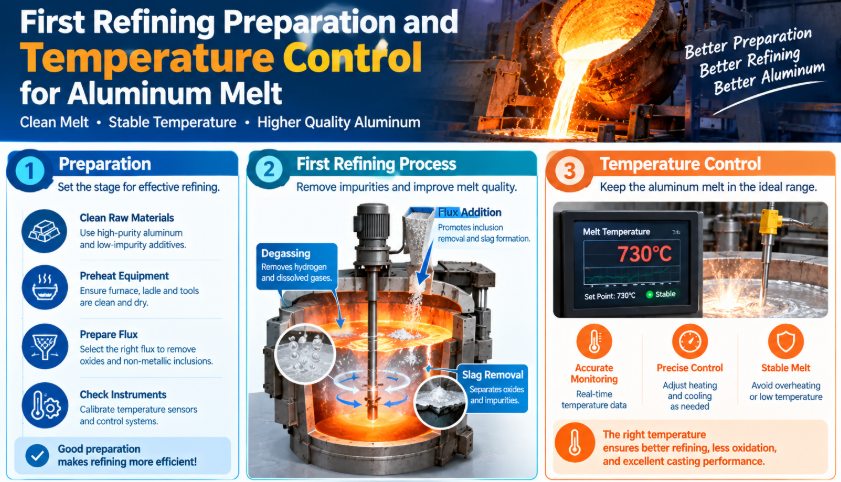
What Preparations Should Be Made Before First Refining? During charging and melting, the floating slag on the melt surface should be skimmed off at the end of the process, and all furnace doors should then be closed. After that, the furnace should be powered on for heat preservation, and the furnace temperature should be set to the specified refining temperature. Before first refining, the furnace temperature should be checked to confirm that it meets the required refining temperature. At the same time, the amount of flux in the furnace should be checked to ensure it is sufficient. The drying furnace temperature should also meet the specified requirement, generally around 150°C. Operating tools must be dried, and their preheating temperature should be kept above 120°C. When refining is required, the furnace power supply should be disconnected, and a “power off for operation” warning sign should be hung at the operating switch. Then open the furnace door at the operating position, while all other furnace doors should remain closed. How Should the First Refining Temperature Be Determined? When selecting the refining temperature, three factors should be considered: the effect of temperature on refining efficiency, the thermal effect between the melt and refining...
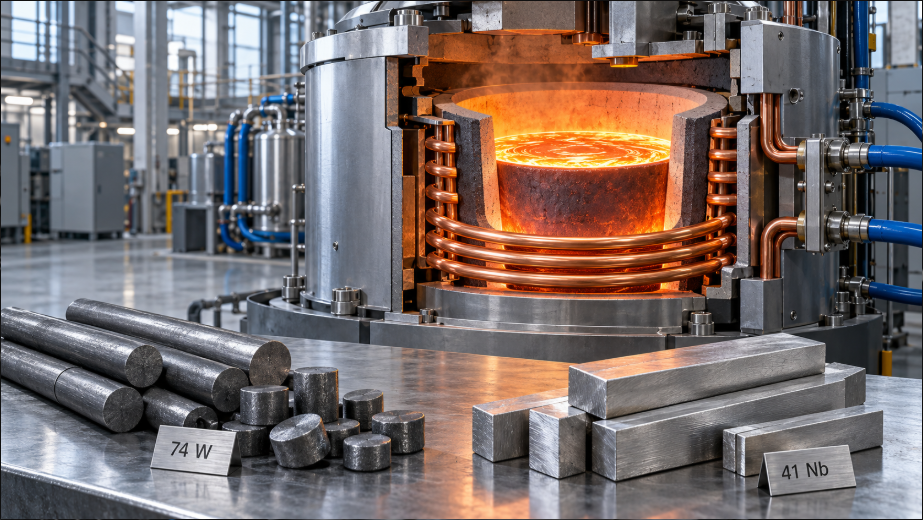
Tungsten and Niobium Charge Materials for Induction Furnaces 1. Metallic Tungsten Metallic tungsten powder is obtained by reducing tungsten trioxide with hydrogen: WO₃ + 3H₂ → 3H₂O + W The tungsten powder is pressed and sintered to produce metallic tungsten bars. Because the WO₃ feedstock has a relatively high purity, the resulting metallic tungsten is also highly pure. Its chemical composition is listed in Table 4-6 of the source. Metallic tungsten is mainly used for melting nickel-based high-temperature alloys, precision alloys, and other alloys with restricted iron contents. It serves as a tungsten-bearing charge material in induction furnace alloy production. 2. Ferrotungsten Ferrotungsten is an iron alloy containing 65%–80% tungsten, together with impurities such as copper, sulfur, and tin. Ferrotungsten containing 65%–70% tungsten has a density of approximately 16.4 g/cm³ and a melting range of 1,700–2,000°C. It is hard and difficult to crush. Ferrotungsten is produced by reducing wolframite concentrate with silicon, aluminum, or carbon in an electric arc furnace. The principal reactions are: FeWO₄ + 4C → W + Fe + 4CO↑ 2FeWO₄ + 4Si → 2W + 2Fe + 4SiO₂ 3FeWO₄ + 8Al → 3W + 3Fe + 4Al₂O₃ Impurity oxides in the concentrate are also reduced and...
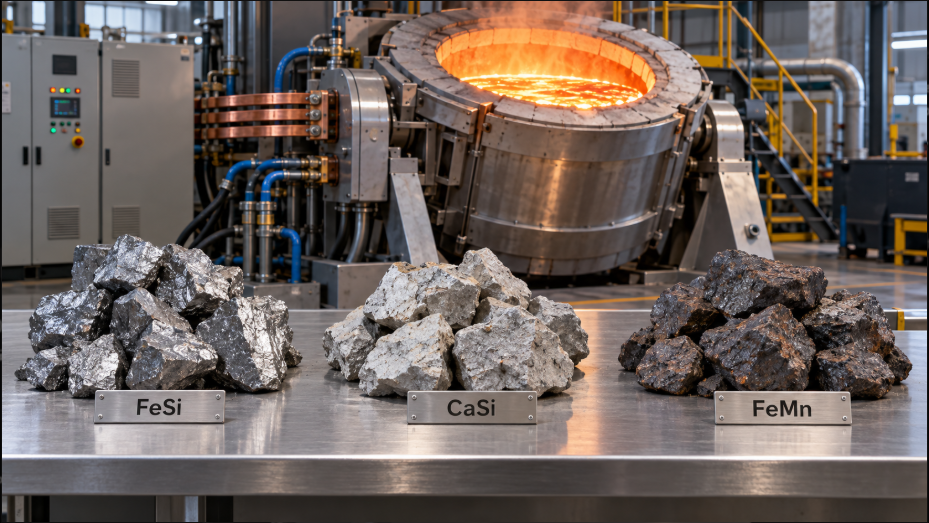
Ferroalloys for Steelmaking and Induction Furnace Melting Ferroalloys and related alloying materials supply silicon, manganese and other elements during steelmaking. They also serve as deoxidizers. When preparing an induction furnace charge, their carbon, phosphorus, sulfur and gas contents must be considered alongside the required alloying elements. 1. Ferrosilicon The reduction reactions associated with ferrosilicon production include: SiO₂ + 2C → Si + 2CO Fe₂O₃ + 3C → 2Fe + 3CO Common ferrosilicon grades and their chemical compositions are listed in Table 4-23. Table 4-23. Ferrosilicon Grades and Chemical Composition — GB 2272-80 All values are percentages. Silicon is given as a range; other listed elements are maximum contents. Grade Si Mn Cr Al Ca P S Si90Al1.5 87.0–95.0 0.4 0.2 1.5 1.5 0.04 0.02 Si90Al3 87.0–95.0 0.4 0.2 3.0 1.5 0.04 0.02 Si75Al1 72.0–80.0 0.5 0.5 1.0 1.0 0.04 0.02 Si75Al1.5 72.0–80.0 0.5 0.5 1.5 1.0 0.04 0.02 Si75 72.0–80.0 0.5 0.5 — — 0.04 0.02 Si65 65.0 to <72.0 0.6 0.5 — — 0.04 0.02 Si45 40.0–47.0 0.7 0.5 — — 0.04 0.02 The aluminum– and calcium-bearing grades Si90Al1.5, Si90Al3, Si75Al1 and Si75Al1.5 are mainly used as deoxidizers. Si45 and Si65 can be used to introduce silicon into the...
Induction Steel Melting Furnace
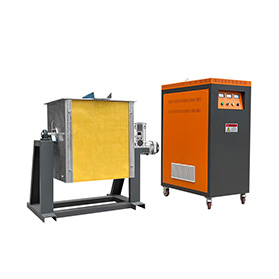
Aluminum Induction Melting Furnace
Stainless Steel Induction Melting Furnace
Medium Frequency Gold Induction Melting Furnace
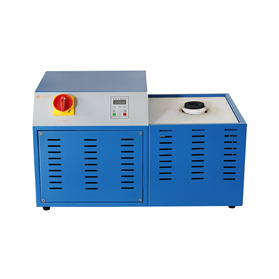
Small Medium Frequency Induction Furnace
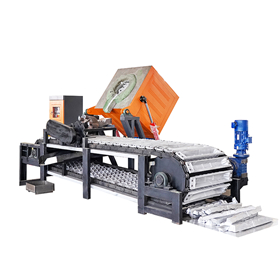
Aluminum/Copper Ingot Continuous Casting Line
Please fill out the form below (required *), send us a short message, and we will contact you as soon as possible.
Send Message
Copyright © 2026 Luoyang Hongteng Electrical Equipment Co., Ltd.